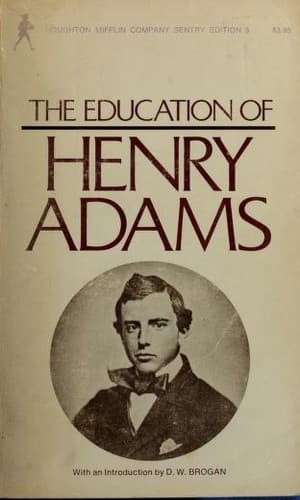
Adams, Henry, 1838-1918; Historians -- United States -- Biography
More than silver and gold, the moral standard interested Adams.
His own interests were with gold, but he supported silver; the Evening
Post's and Godkin's interests were with gold, and they frankly said so,
yet they avowedly pursued their interests even into politics; Cameron's
interests had always been with the corporations, yet he supported
silver. Thus morality required that Adams should be condemned for going
against his interests; that Godkin was virtuous in following his
interests; and that Cameron was a scoundrel whatever he did.
Granting that one of the three was a moral idiot, which was it:--Adams
or Godkin or Cameron? Until a Council or a Pope or a Congress or the
newspapers or a popular election has decided a question of doubtful
morality, individuals are apt to err, especially when putting money
into their own pockets; but in democracies, the majority alone gives
law. To any one who knew the relative popularity of Cameron and Godkin,
the idea of a popular vote between them seemed excessively humorous;
yet the popular vote in the end did decide against Cameron, for Godkin.
The Boston moralist and reformer went on, as always, like Dr.
Johnson, impatiently stamping his foot and following his interests, or
his antipathies; but the true American, slow to grasp new and
complicated ideas, groped in the dark to discover where his greater
interest lay. As usual, the banks taught him. In the course of fifty
years the banks taught one many wise lessons for which an insect had to
be grateful whether it liked them or not; but of all the lessons Adams
learned from them, none compared in dramatic effect with that of July
22, 1893, when, after talking silver all the morning with Senator
Cameron on the top of their travelling-carriage crossing the Furka
Pass, they reached Lucerne in the afternoon, where Adams found letters
from his brothers requesting his immediate return to Boston because the
community was bankrupt and he was probably a beggar.
If he wanted education, he knew no quicker mode of learning a
lesson than that of being struck on the head by it; and yet he was
himself surprised at his own slowness to understand what had struck
him. For several years a sufferer from insomnia, his first thought was
of beggary of nerves, and he made ready to face a sleepless night, but
although his mind tried to wrestle with the problem how any man could
be ruined who had, months before, paid off every dollar of debt he knew
himself to owe, he gave up that insoluble riddle in order to fall back
on the larger principle that beggary could be no more for him than it
was for others who were more valuable members of society, and, with
that, he went to sleep like a good citizen, and the next day started
for Quincy where he arrived August 7.
Public-domain text, read in full here on John Shaqi.
Reviews
Reviews
No reviews yet
Be the first to share your thoughts on this work.
Elsewhere in the archive
Join the Discussion
Join the discussion
Sign in to leave a comment or review.
Sign InorCreate an account