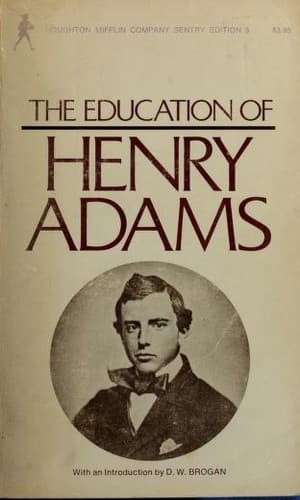
Adams, Henry, 1838-1918; Historians -- United States -- Biography
The answer was not what he had meant it to be, and he was not
likely to better it by asking his father, in turn, what equivalent his
brothers or cousins or friends at home had got out of the same time and
money spent in Boston. All they had put into the law was certainly
thrown away, but were they happier in science? In theory one might say,
with some show of proof, that a pure, scientific education was alone
correct; yet many of his friends who took it, found reason to complain
that it was anything but a pure, scientific world in which they lived.
Meanwhile his father had quite enough perplexities of his own,
without seeking more in his son's errors. His Quincy district had sent
him to Congress, and in the spring of 1860 he was in the full confusion
of nominating candidates for the Presidential election in November. He
supported Mr. Seward. The Republican Party was an unknown force, and
the Democratic Party was torn to pieces. No one could see far into the
future. Fathers could blunder as well as sons, and, in 1860, every one
was conscious of being dragged along paths much less secure than those
of the European tourist. For the time, the young man was safe from
interference, and went on his way with a light heart to take whatever
chance fragments of education God or the devil was pleased to give him,
for he knew no longer the good from the bad.
He had of both sorts more than he knew how to use. Perhaps the
most useful purpose he set himself to serve was that of his pen, for he
wrote long letters, during the next three months, to his brother
Charles, which his brother caused to be printed in the Boston Courier;
and the exercise was good for him. He had little to say, and said it
not very well, but that mattered less. The habit of expression leads to
the search for something to express. Something remains as a residuum of
the commonplace itself, if one strikes out every commonplace in the
expression. Young men as a rule saw little in Italy, or anywhere else,
and in after life when Adams began to learn what some men could see, he
shrank into corners of shame at the thought that he should have
betrayed his own inferiority as though it were his pride, while he
invited his neighbors to measure and admire; but it was still the
nearest approach he had yet made to an intelligent act.
Public-domain text, read in full here on John Shaqi.
Reviews
Reviews
No reviews yet
Be the first to share your thoughts on this work.
Elsewhere in the archive
Join the Discussion
Join the discussion
Sign in to leave a comment or review.
Sign InorCreate an account