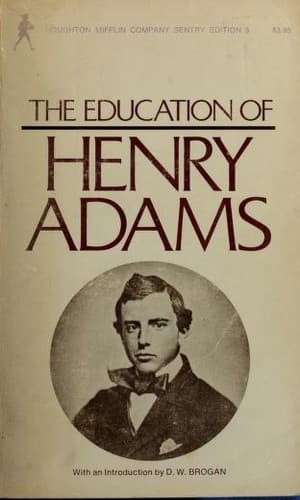
Adams, Henry, 1838-1918; Historians -- United States -- Biography
He told all about it to the Boston Courier; where the narrative
probably exists to this day, unless the files of the Courier have
wholly perished; but of its bearing on education the Courier did not
speak. He himself would have much liked to know whether it had any
bearing whatever, and what was its value as a post-graduate course.
Quite apart from its value as life attained, realized, capitalized, it
had also a certain value as a lesson in something, though Adams could
never classify the branch of study. Loosely, the tourist called it
knowledge of men, but it was just the reverse; it was knowledge of
one's ignorance of men. Captain Palmer of the Iroquois, who was a
friend of the young man's uncle, Sydney Brooks, took him with the
officers of the ship to make an evening call on Garibaldi, whom they
found in the Senate House towards sunset, at supper with his
picturesque and piratic staff, in the full noise and color of the
Palermo revolution. As a spectacle, it belonged to Rossini and the
Italian opera, or to Alexandre Dumas at the least, but the spectacle
was not its educational side. Garibaldi left the table, and, sitting
down at the window, had a few words of talk with Captain Palmer and
young Adams. At that moment, in the summer of 1860, Garibaldi was
certainly the most serious of the doubtful energies in the world; the
most essential to gauge rightly. Even then society was dividing between
banker and anarchist. One or the other, Garibaldi must serve. Himself a
typical anarchist, sure to overshadow Europe and alarm empires bigger
than Naples, his success depended on his mind; his energy was beyond
doubt.
Adams had the chance to look this sphinx in the eyes, and, for
five minutes, to watch him like a wild animal, at the moment of his
greatest achievement and most splendid action. One saw a
quiet-featured, quiet-voiced man in a red flannel shirt; absolutely
impervious; a type of which Adams knew nothing. Sympathetic it was, and
one felt that it was simple; one suspected even that it might be
childlike, but could form no guess of its intelligence. In his own eyes
Garibaldi might be a Napoleon or a Spartacus; in the hands of Cavour he
might become a Condottiere; in the eyes of history he might, like the
rest of the world, be only the vigorous player in the game he did not
understand. The student was none the wiser.
Public-domain text, read in full here on John Shaqi.
Reviews
Reviews
No reviews yet
Be the first to share your thoughts on this work.
Elsewhere in the archive
Join the Discussion
Join the discussion
Sign in to leave a comment or review.
Sign InorCreate an account