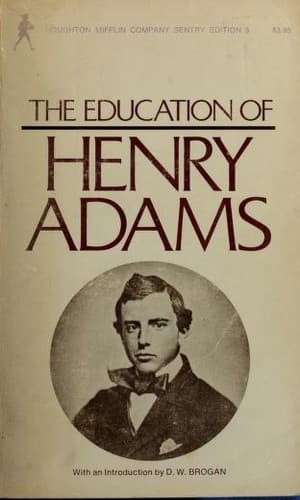
Adams, Henry, 1838-1918; Historians -- United States -- Biography
Yet Browning never revealed the poetic depths of Saint Francis;
William Story could not touch the secret of Michael Angelo, and Mommsen
hardly said all that one felt by instinct in the lives of Cicero and
Caesar. They taught what, as a rule, needed no teaching, the lessons of
a rather cheap imagination and cheaper politics. Rome was a bewildering
complex of ideas, experiments, ambitions, energies; without her, the
Western world was pointless and fragmentary; she gave heart and unity
to it all; yet Gibbon might have gone on for the whole century, sitting
among the ruins of the Capitol, and no one would have passed, capable
of telling him what it meant. Perhaps it meant nothing.
So it ended; the happiest month of May that life had yet
offered, fading behind the present, and probably beyond the past,
somewhere into abstract time, grotesquely out of place with the Berlin
scheme or a Boston future. Adams explained to himself that he was
absorbing knowledge. He would have put it better had he said that
knowledge was absorbing him. He was passive. In spite of swarming
impressions he knew no more when he left Rome than he did when he
entered it. As a marketable object, his value was less. His next step
went far to convince him that accidental education, whatever its
economical return might be, was prodigiously successful as an object in
itself. Everything conspired to ruin his sound scheme of life, and to
make him a vagrant as well as pauper. He went on to Naples, and there,
in the hot June, heard rumors that Garibaldi and his thousand were
about to attack Palermo. Calling on the American Minister, Chandler of
Pennsylvania, he was kindly treated, not for his merit, but for his
name, and Mr. Chandler amiably consented to send him to the seat of war
as bearer of despatches to Captain Palmer of the American sloop of war
Iroquois. Young Adams seized the chance, and went to Palermo in a
government transport filled with fleas, commanded by a charming Prince
Caracciolo.
Public-domain text, read in full here on John Shaqi.
Reviews
Reviews
No reviews yet
Be the first to share your thoughts on this work.
Elsewhere in the archive
Join the Discussion
Join the discussion
Sign in to leave a comment or review.
Sign InorCreate an account