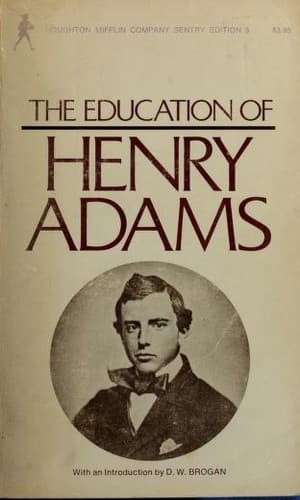
Adams, Henry, 1838-1918; Historians -- United States -- Biography
He did this in good faith, obeying the lessons his teachers had
taught him; but the curious result followed that, being in no way
responsible for the French and sincerely disapproving them, he felt
quite at liberty to enjoy to the full everything he disapproved. Stated
thus crudely, the idea sounds derisive; but, as a matter of fact,
several thousand Americans passed much of their time there on this
understanding. They sought to take share in every function that was
open to approach, as they sought tickets to the opera, because they
were not a part of it. Adams did like the rest. All thought of serious
education had long vanished. He tried to acquire a few French idioms,
without even aspiring to master a subjunctive, but he succeeded better
in acquiring a modest taste for Bordeaux and Burgundy and one or two
sauces; for the Trois Freres Provencaux and Voisin's and Philippe's and
the Cafe Anglais; for the Palais Royal Theatre, and the Varietes and
the Gymnase; for the Brohans and Bressant, Rose Cheri and Gil Perez,
and other lights of the stage. His friends were good to him. Life was
amusing. Paris rapidly became familiar. In a month or six weeks he
forgot even to disapprove of it; but he studied nothing, entered no
society, and made no acquaintance. Accidental education went far in
Paris, and one picked up a deal of knowledge that might become useful;
perhaps, after all, the three months passed there might serve better
purpose than the twenty-one months passed elsewhere; but he did not
intend it--did not think it--and looked at it as a momentary and
frivolous vacation before going home to fit himself for life.
Therewith, after staying as long as he could and spending all the money
he dared, he started with mixed emotions but no education, for home.
CHAPTER VII
TREASON (1860-1861)
WHEN, forty years afterwards, Henry Adams looked back over his
adventures in search of knowledge, he asked himself whether fortune or
fate had ever dealt its cards quite so wildly to any of his known
antecessors as when it led him to begin the study of law and to vote
for Abraham Lincoln on the same day.
He dropped back on Quincy like a lump of lead; he rebounded
like a football, tossed into space by an unknown energy which played
with all his generation as a cat plays with mice. The simile is none
too strong. Not one man in America wanted the Civil War, or expected or
intended it. A small minority wanted secession. The vast majority
wanted to go on with their occupations in peace. Not one, however
clever or learned, guessed what happened. Possibly a few Southern
loyalists in despair might dream it as an impossible chance; but none
planned it.
Public-domain text, read in full here on John Shaqi.
Reviews
Reviews
No reviews yet
Be the first to share your thoughts on this work.
Elsewhere in the archive
Join the Discussion
Join the discussion
Sign in to leave a comment or review.
Sign InorCreate an account