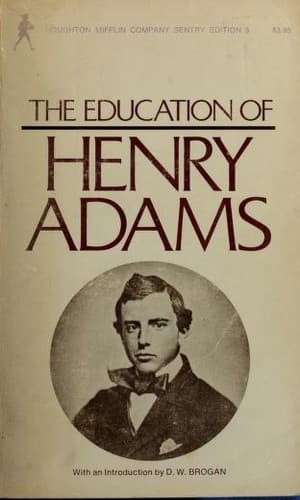
Adams, Henry, 1838-1918; Historians -- United States -- Biography
As for Henry Adams, fresh from Europe and chaos of another
sort, he plunged at once into a lurid atmosphere of politics, quite
heedless of any education or forethought. His past melted away. The
prodigal was welcomed home, but not even his father asked a malicious
question about the Pandects. At the utmost, he hinted at some shade of
prodigality by quietly inviting his son to act as private secretary
during the winter in Washington, as though any young man who could
afford to throw away two winters on the Civil Law could afford to read
Blackstone for another winter without a master. The young man was
beyond satire, and asked only a pretext for throwing all education to
the east wind. November at best is sad, and November at Quincy had been
from earliest childhood the least gay of seasons. Nowhere else does the
uncharitable autumn wreak its spite so harshly on the frail wreck of
the grasshopper summer; yet even a Quincy November seemed temperate
before the chill of a Boston January.
This was saying much, for the November of 1860 at Quincy stood
apart from other memories as lurid beyond description. Although no one
believed in civil war, the air reeked of it, and the Republicans
organized their clubs and parades as Wide-Awakes in a form military in
all things except weapons. Henry reached home in time to see the last
of these processions, stretching in ranks of torches along the
hillside, file down through the November night; to the Old House, where
Mr. Adams, their Member of Congress, received them, and, let them
pretend what they liked, their air was not that of innocence.
Profoundly ignorant, anxious, and curious, the young man packed
his modest trunk again, which had not yet time to be unpacked, and
started for Washington with his family. Ten years had passed since his
last visit, but very little had changed. As in 1800 and 1850, so in
1860, the same rude colony was camped in the same forest, with the same
unfinished Greek temples for work rooms, and sloughs for roads. The
Government had an air of social instability and incompleteness that
went far to support the right of secession in theory as in fact; but
right or wrong, secession was likely to be easy where there was so
little to secede from. The Union was a sentiment, but not much more,
and in December, 1860, the sentiment about the Capitol was chiefly
hostile, so far as it made itself felt. John Adams was better off in
Philadelphia in 1776 than his great-grandson Henry in 1860 in
Washington.
Public-domain text, read in full here on John Shaqi.
Reviews
Reviews
No reviews yet
Be the first to share your thoughts on this work.
Elsewhere in the archive
Join the Discussion
Join the discussion
Sign in to leave a comment or review.
Sign InorCreate an account