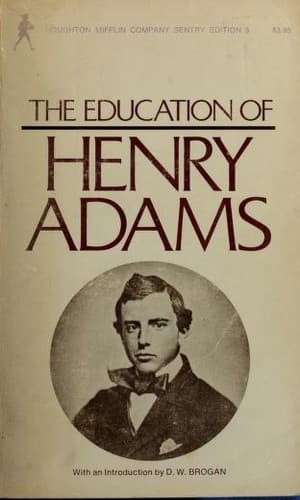
Adams, Henry, 1838-1918; Historians -- United States -- Biography
Perforce, the student was thrown back on Northern precept and
example; first of all, on his New England surroundings. Republican
houses were few in Washington, and Mr. and Mrs. Adams aimed to create a
social centre for New Englanders. They took a house on I Street,
looking over Pennsylvania Avenue, well out towards Georgetown--the
Markoe house--and there the private secretary began to learn his social
duties, for the political were confined to committee-rooms and lobbies
of the Capitol. He had little to do, and knew not how to do it rightly,
but he knew of no one who knew more.
The Southern type was one to be avoided; the New England type
was one's self. It had nothing to show except one's own features.
Setting aside Charles Sumner, who stood quite alone and was the boy's
oldest friend, all the New Englanders were sane and steady men,
well-balanced, educated, and free from meanness or intrigue--men whom
one liked to act with, and who, whether graduates or not, bore the
stamp of Harvard College. Anson Burlingame was one exception, and
perhaps Israel Washburn another; but as a rule the New Englander's
strength was his poise which almost amounted to a defect. He offered no
more target for love than for hate; he attracted as little as he
repelled; even as a machine, his motion seemed never accelerated. The
character, with its force or feebleness, was familiar; one knew it to
the core; one was it--had been run in the same mould.
There remained the Central and Western States, but there the
choice of teachers was not large and in the end narrowed itself to
Preston King, Henry Winter Davis, Owen Lovejoy, and a few other men
born with social faculty. Adams took most kindly to Henry J. Raymond,
who came to view the field for the New York Times, and who was a man of
the world. The average Congressman was civil enough, but had nothing to
ask except offices, and nothing to offer but the views of his district.
The average Senator was more reserved, but had not much more to say,
being always excepting one or two genial natures, handicapped by his
own importance.
Study it as one might, the hope of education, till the arrival
of the President-elect, narrowed itself to the possible influence of
only two men--Sumner and Seward.
Public-domain text, read in full here on John Shaqi.
Reviews
Reviews
No reviews yet
Be the first to share your thoughts on this work.
Elsewhere in the archive
Join the Discussion
Join the discussion
Sign in to leave a comment or review.
Sign InorCreate an account