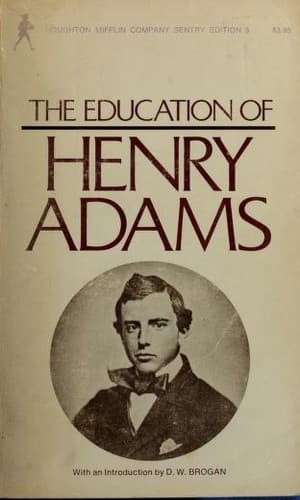
Adams, Henry, 1838-1918; Historians -- United States -- Biography
Sumner was then fifty years old. Since his election as Senator
in 1851 he had passed beyond the reach of his boy friend, and, after
his Brooks injuries, his nervous system never quite recovered its tone;
but perhaps eight or ten years of solitary existence as Senator had
most to do with his development. No man, however strong, can serve ten
years as schoolmaster, priest, or Senator, and remain fit for anything
else. All the dogmatic stations in life have the effect of fixing a
certain stiffness of attitude forever, as though they mesmerized the
subject. Yet even among Senators there were degrees in dogmatism, from
the frank South Carolinian brutality, to that of Webster, Benton, Clay,
or Sumner himself, until in extreme cases, like Conkling, it became
Shakespearian and bouffe--as Godkin used to call it--like Malvolio.
Sumner had become dogmatic like the rest, but he had at least the merit
of qualities that warranted dogmatism. He justly thought, as Webster
had thought before him, that his great services and sacrifices, his
superiority in education, his oratorical power, his political
experience, his representative character at the head of the whole New
England contingent, and, above all, his knowledge of the world, made
him the most important member of the Senate; and no Senator had ever
saturated himself more thoroughly with the spirit and temper of the
body.
Although the Senate is much given to admiring in its members a
superiority less obvious or quite invisible to outsiders, one Senator
seldom proclaims his own inferiority to another, and still more seldom
likes to be told of it. Even the greatest Senators seemed to inspire
little personal affection in each other, and betrayed none at all.
Sumner had a number of rivals who held his judgment in no high esteem,
and one of these was Senator Seward. The two men would have disliked
each other by instinct had they lived in different planets. Each was
created only for exasperating the other; the virtues of one were the
faults of his rival, until no good quality seemed to remain of either.
That the public service must suffer was certain, but what were the
sufferings of the public service compared with the risks run by a young
mosquito--a private secretary--trying to buzz admiration in the ears of
each, and unaware that each would impatiently slap at him for belonging
to the other? Innocent and unsuspicious beyond what was permitted even
in a nursery, the private secretary courted both.
Public-domain text, read in full here on John Shaqi.
Reviews
Reviews
No reviews yet
Be the first to share your thoughts on this work.
Elsewhere in the archive
Join the Discussion
Join the discussion
Sign in to leave a comment or review.
Sign InorCreate an account