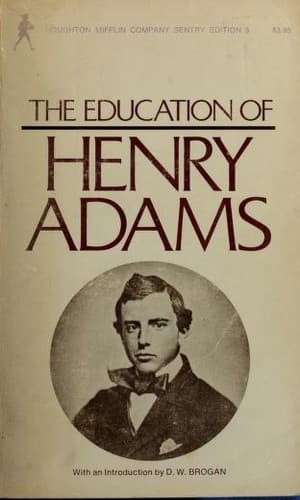
Adams, Henry, 1838-1918; Historians -- United States -- Biography
As far as a young man of anxious temperament could see, no one
in Washington was fitted for his duties; or rather, no duties in March
were fitted for the duties in April. The few people who thought they
knew something were more in error than those who knew nothing.
Education was matter of life and death, but all the education in the
world would have helped nothing. Only one man in Adams's reach seemed
to him supremely fitted by knowledge and experience to be an adviser
and friend. This was Senator Sumner; and there, in fact, the young
man's education began; there it ended.
Going over the experience again, long after all the great
actors were dead, he struggled to see where he had blundered. In the
effort to make acquaintances, he lost friends, but he would have liked
much to know whether he could have helped it. He had necessarily
followed Seward and his father; he took for granted that his business
was obedience, discipline, and silence; he supposed the party to
require it, and that the crisis overruled all personal doubts. He was
thunderstruck to learn that Senator Sumner privately denounced the
course, regarded Mr. Adams as betraying the principles of his life, and
broke off relations with his family.
Many a shock was Henry Adams to meet in the course of a long
life passed chiefly near politics and politicians, but the profoundest
lessons are not the lessons of reason; they are sudden strains that
permanently warp the mind. He cared little or nothing about the point
in discussion; he was even willing to admit that Sumner might be right,
though in all great emergencies he commonly found that every one was
more or less wrong; he liked lofty moral principle and cared little for
political tactics; he felt a profound respect for Sumner himself; but
the shock opened a chasm in life that never closed, and as long as life
lasted, he found himself invariably taking for granted, as a political
instinct, with out waiting further experiment--as he took for granted
that arsenic poisoned--the rule that a friend in power is a friend lost.
On his own score, he never admitted the rupture, and never
exchanged a word with Mr. Sumner on the subject, then or afterwards,
but his education--for good or bad--made an enormous stride. One has to
deal with all sorts of unexpected morals in life, and, at this moment,
he was looking at hundreds of Southern gentlemen who believed
themselves singularly honest, but who seemed to him engaged in the
plainest breach of faith and the blackest secret conspiracy, yet they
did not disturb his education. History told of little else; and not one
rebel defection--not even Robert E. Lee's--cost young Adams a personal
pang; but Sumner's struck home.
Public-domain text, read in full here on John Shaqi.
Reviews
Reviews
No reviews yet
Be the first to share your thoughts on this work.
Elsewhere in the archive
Join the Discussion
Join the discussion
Sign in to leave a comment or review.
Sign InorCreate an account