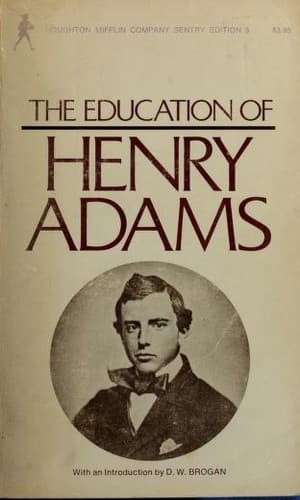
Adams, Henry, 1838-1918; Historians -- United States -- Biography
They won their game; this was their affair and the affair of
the historians who tell their story; their private secretaries had
nothing to do with it except to follow their orders. On that side a
secretary learned nothing and had nothing to learn. The sudden arrival
of Mr. Lincoln in Washington on February 23, and the language of his
inaugural address, were the final term of the winter's tactics, and
closed the private secretary's interest in the matter forever. Perhaps
he felt, even then, a good deal more interest in the appearance of
another private secretary, of his own age, a young man named John Hay,
who lighted on LaFayette Square at the same moment. Friends are born,
not made, and Henry never mistook a friend except when in power. From
the first slight meeting in February and March, 1861, he recognized Hay
as a friend, and never lost sight of him at the future crossing of
their paths; but, for the moment, his own task ended on March 4 when
Hay's began. The winter's anxieties were shifted upon new shoulders,
and Henry gladly turned back to Blackstone. He had tried to make
himself useful, and had exerted energy that seemed to him portentous,
acting in secret as newspaper correspondent, cultivating a large
acquaintance and even haunting ballrooms where the simple,
old-fashioned, Southern tone was pleasant even in the atmosphere of
conspiracy and treason. The sum was next to nothing for education,
because no one could teach; all were as ignorant as himself; none knew
what should be done, or how to do it; all were trying to learn and were
more bent on asking than on answering questions. The mass of ignorance
in Washington was lighted up by no ray of knowledge. Society, from top
to bottom, broke down.
From this law there was no exception, unless, perhaps, that of
old General Winfield Scott, who happened to be the only military figure
that looked equal to the crisis. No one else either looked it, or was
it, or could be it, by nature or training. Had young Adams been told
that his life was to hang on the correctness of his estimate of the new
President, he would have lost. He saw Mr. Lincoln but once; at the
melancholy function called an Inaugural Ball. Of course he looked
anxiously for a sign of character. He saw a long, awkward figure; a
plain, ploughed face; a mind, absent in part, and in part evidently
worried by white kid gloves; features that expressed neither
self-satisfaction nor any other familiar Americanism, but rather the
same painful sense of becoming educated and of needing education that
tormented a private secretary; above all a lack of apparent force. Any
private secretary in the least fit for his business would have thought,
as Adams did, that no man living needed so much education as the new
President but that all the education he could get would not be enough.
Public-domain text, read in full here on John Shaqi.
Reviews
Reviews
No reviews yet
Be the first to share your thoughts on this work.
Elsewhere in the archive
Join the Discussion
Join the discussion
Sign in to leave a comment or review.
Sign InorCreate an account