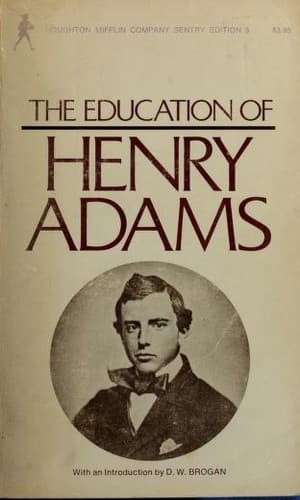
Adams, Henry, 1838-1918; Historians -- United States -- Biography
The situation did not seem even comic, so ignorant was the
world of its humors; yet Minister Adams sailed for England, May 1,
1861, with much the same outfit as Admiral Dupont would have enjoyed if
the Government had sent him to attack Port Royal with one cabin-boy in
a rowboat. Luckily for the cabin-boy, he was alone. Had Secretary
Seward and Senator Sumner given to Mr. Adams the rank of Ambassador and
four times his salary, a palace in London, a staff of trained
secretaries, and personal letters of introduction to the royal family
and the whole peerage, the private secretary would have been cabin-boy
still, with the extra burden of many masters; he was the most fortunate
person in the party, having for master only his father who never
fretted, never dictated, never disciplined, and whose idea of American
diplomacy was that of the eighteenth century. Minister Adams remembered
how his grandfather had sailed from Mount Wollaston in midwinter, 1778,
on the little frigate Boston, taking his eleven-year-old son John
Quincy with him, for secretary, on a diplomacy of adventure that had
hardly a parallel for success. He remembered how John Quincy, in 1809,
had sailed for Russia, with himself, a baby of two years old, to cope
with Napoleon and the Czar Alexander single-handed, almost as much of
an adventurer as John Adams before him, and almost as successful. He
thought it natural that the Government should send him out as an
adventurer also, with a twenty-three-year-old son, and he did not even
notice that he left not a friend behind him. No doubt he could depend
on Seward, but on whom could Seward depend? Certainly not on the
Chairman of the Committee of Foreign Relations. Minister Adams had no
friend in the Senate; he could hope for no favors, and he asked none.
He thought it right to play the adventurer as his father and
grandfather had done before him, without a murmur. This was a lofty
view, and for him answered his objects, but it bore hard on cabin-boys,
and when, in time, the young man realized what had happened, he felt it
as a betrayal. He modestly thought himself unfit for the career of
adventurer, and judged his father to be less fit than himself. For the
first time America was posing as the champion of legitimacy and order.
Her representatives should know how to play their role; they should
wear the costume; but, in the mission attached to Mr. Adams in 1861,
the only rag of legitimacy or order was the private secretary, whose
stature was not sufficient to impose awe on the Court and Parliament of
Great Britain.
Public-domain text, read in full here on John Shaqi.
Reviews
Reviews
No reviews yet
Be the first to share your thoughts on this work.
Elsewhere in the archive
Join the Discussion
Join the discussion
Sign in to leave a comment or review.
Sign InorCreate an account