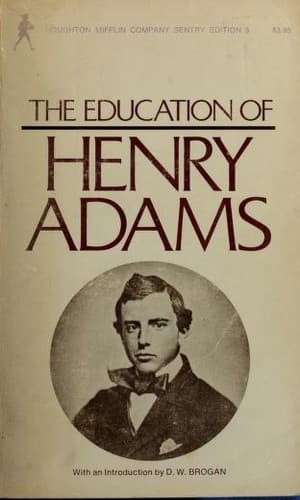
Adams, Henry, 1838-1918; Historians -- United States -- Biography
One inevitable effect of this lesson was to make a victim of
the scholar and to turn him into a harsh judge of his masters. If they
overlooked him, he could hardly overlook them, since they stood with
their whole weight on his body. By way of teaching him quickly, they
sent out their new Minister to Russia in the same ship. Secretary
Seward had occasion to learn the merits of Cassius M. Clay in the
diplomatic service, but Mr. Seward's education profited less than the
private secretary's, Cassius Clay as a teacher having no equal though
possibly some rivals. No young man, not in Government pay, could be
asked to draw, from such lessons, any confidence in himself, and it was
notorious that, for the next two years, the persons were few indeed who
felt, or had reason to feel, any sort of confidence in the Government;
fewest of all among those who were in it. At home, for the most part,
young men went to the war, grumbled and died; in England they might
grumble or not; no one listened.
Above all, the private secretary could not grumble to his
chief. He knew surprisingly little, but that much he did know. He never
labored so hard to learn a language as he did to hold his tongue, and
it affected him for life. The habit of reticence--of talking without
meaning--is never effaced. He had to begin it at once. He was already
an adept when the party landed at Liverpool, May 13, 1861, and went
instantly up to London: a family of early Christian martyrs about to be
flung into an arena of lions, under the glad eyes of Tiberius
Palmerston. Though Lord Palmerston would have laughed his peculiar
Palmerston laugh at figuring as Tiberius, he would have seen only
evident resemblance in the Christian martyrs, for he had already
arranged the ceremony.
Of what they had to expect, the Minister knew no more than his
son. What he or Mr. Seward or Mr. Sumner may have thought is the affair
of history and their errors concern historians. The errors of a private
secretary concerned no one but himself, and were a large part of his
education. He thought on May 12 that he was going to a friendly
Government and people, true to the anti-slavery principles which had
been their steadiest profession. For a hundred years the chief effort
of his family had aimed at bringing the Government of England into
intelligent cooperation with the objects and interests of America. His
father was about to make a new effort, and this time the chance of
success was promising. The slave States had been the chief apparent
obstacle to good understanding. As for the private secretary himself,
he was, like all Bostonians, instinctively English. He could not
conceive the idea of a hostile England. He supposed himself, as one of
the members of a famous anti-slavery family, to be welcome everywhere
in the British Islands.
Public-domain text, read in full here on John Shaqi.
Reviews
Reviews
No reviews yet
Be the first to share your thoughts on this work.
Elsewhere in the archive
Join the Discussion
Join the discussion
Sign in to leave a comment or review.
Sign InorCreate an account