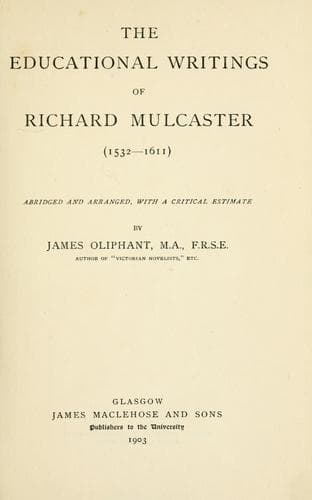
The Educational Writings of Richard MulcasterMulcaster, Richard
History
The Educational Writings of Richard Mulcaster
Mulcaster, Richard
Education -- History
enjoins us to avoid contention, even by the submission of those
who are wronged, and charges us to defend our religion, not with
passionate minds, but with the armour of patience and truth. These
were the blemishes which I saw by the way, and lamented in the body
of learning. The amendment which I desire rests upon two great
pillars--the professors of learning, who must give intelligence of
the error, and the principal magistrates--nay, even the sovereign
prince--who being God’s great instruments to procure quietness
for our souls and bodies, our goods and actions, must bring about
redress in so important a matter as the course of learning.
The prince may cut off what is in excess, make up what is
deficient, reconcile diversities, expel dissensions, by his lawful
authority for the general good; and everyone will submit, because
everyone is benefited. This, indeed, confirms Plato’s saying
that kings should be philosophers; that is, that all magistrates
should be learned. It is a great corrosive to the whole body of
learning, which is the procurer of peace, when those who have to
direct gain their wisdom only through experience. That is much,
but experience and learning together make the better equipment. It
is an honourable conception, besides that it tends to the general
good, for a learned and virtuous prince, assisted by wise counsel,
to reduce the number of those that follow learning, by some
principle of selection in every department, to decide what kinds of
learning are most useful to the State, and to appoint a reasonable
number of such books as have the best methods of treatment. The
final authority in regard to every profession has always lain with
the prince. Action has been taken before in all the directions
I have spoken of, both by consent of the learned and by command
of good princes. As our country is small, the thing could be
the more easily done; as our livings are limited, it is the more
needful; as the evil is great, we are the less able to bear it; as
our sovereign is learned, we shall be the readier to give ear; as
our people are of good understanding, they are the better able to
inform her. But as the physician does not thrive by the prevention
of disease, nor the lawyer grow rich by arresting contentions, nor
a divine prosper so much in a heaven where all is good as on earth
where all is evil, and as private profit will be followed, though
it bring confusion to the State, redress will not stir, because it
judges the world to be in some fault which it is loth to confess.
However, to secure some redress and help in this matter at the hand
of the ruler, is the duty of all who make a profession of learning,
if they will but consider the reputation of learning in our day,
whether from the contempt in which some professions are held, or
from a deficiency in those who enter them.
Public-domain text, read in full here on John Shaqi.
Reviews
Reviews
No reviews yet
Be the first to share your thoughts on this work.
Elsewhere in the archive
Join the Discussion
Join the discussion
Sign in to leave a comment or review.
Sign InorCreate an account