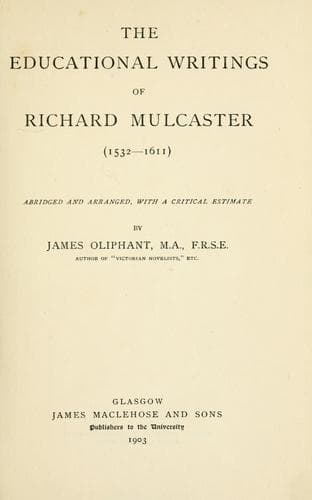
The Educational Writings of Richard MulcasterMulcaster, Richard
History
The Educational Writings of Richard Mulcaster
Mulcaster, Richard
Education -- History
In the professors of learning, to whose solicitation this point
is recommended, two things are chiefly required. First, that with
minds given to peace they should study soundly themselves, and that
the matter be worthy and taken in due order. For sound learning
will not so soon be shaken at every eager point of controversy
as that which is shallow. Orderly progress gives security, and a
pacific temper furthers the end that is desired both privately and
publicly. The consent of the learned and their quiet inclination
are a great blessing to any Commonwealth, but especially to ours
in this contentious time, when overwhetted minds do very little
good to some worthy professions. The distracting division of
minds into sects and sorts of philosophy did much injury in the
countries where it befel, and those nations among which religious
dissensions arose have never been quiet since. The second point
required in a student is not to seek his own advancement so much as
that of the things he professes, and indeed the possession of these
things is the best means to advance himself, for, where ignorance
is blamed, knowledge is approved, even though the approver may not
be learned. He who studies soundly recommends letters by his own
example; he who solicits the help of those in authority advances
learning still further; he who uses his pen to strengthen the best
current of opinion proves the genuineness of his desire by his
own practice. In this last form my own labour seeks to recommend
uniformity, to strip off what is needless, to supply some defects,
to help everyone to as quiet a course as I can temper my style to.
The second question which I said might be demanded of me, why I do
not follow the precedent of those learned writers who have handled
the subject with great admiration may be very soon answered. I
admit that the number of those who have written upon the upbringing
of children might be considered sufficient, and I grant the
excellence of many of them, such as Bembus, Sturmius, and Erasmus.
But the situation is different. A free city and a country under a
monarchy are not in the same position, though they agree in some
general respects, in which indeed these writers do not dissent from
me. Nor do I fail to follow good writers, taking example from those
authors who taught all the later ones to write so well. I am the
servant of my country; for her sake I labour, her circumstances I
must consider, and whatsoever I shall pen I shall myself see it
carried out, by the grace of God, in order the better to persuade
others by offering the proof of trial.
Public-domain text, read in full here on John Shaqi.
Reviews
Reviews
No reviews yet
Be the first to share your thoughts on this work.
Elsewhere in the archive
Join the Discussion
Join the discussion
Sign in to leave a comment or review.
Sign InorCreate an account