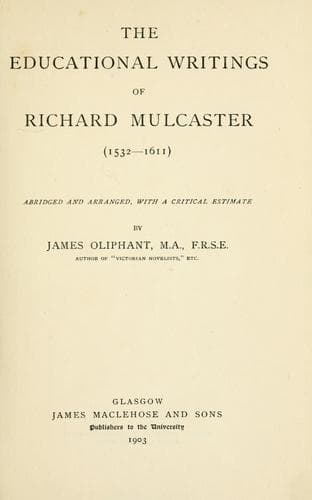
The Educational Writings of Richard MulcasterMulcaster, Richard
History
The Educational Writings of Richard Mulcaster
Mulcaster, Richard
Education -- History
I must have regard as well to those from whom my learning is
borrowed, that they may say they meant it so, as to those for whom
it is borrowed, that they may say they understand it.”
The writer who does otherwise may be thought plain by those who
seek nothing far, but if those who call for plainness are always
to be pleased, and dealt with so daintily that they are put to
no pains to learn and enquire, when they find themselves in a
difficulty through their own ignorance; if they must be made a
lure for learning to descend to, rather degenerating herself than
teaching them to look up, what is the use of skill? He who made
the earth made hills and dales, heights and plains, smooth places
and rough, and yet all good of their own kind. Plainness is good
for a pleasant course, and a popular style is in place in ordinary
argument, where no art is needed because the reader knows none,
and the matter can be simply expressed, being indeed in her best
colours when she is dressed for common purposes. Likewise this
alleged hardness, though it belong to the matter, has its special
use in whetting people’s wits, and making a deep impression, where
what seems dark contains something that must be considered thrice
before it is mastered.
Labour is the coin which is current in heaven, for which and by
which Almighty God sells His best wares, though in His great
goodness He sometimes does more for some in giving them quickness
and intelligence, even without great labour, than any labour can do
for others, in order to let us know that His mercy is the mistress
when our labour learns best. But in our ordinary life, if carpeting
be knighting, where is necessary defence? If easy understanding
be the readiest learning, then wake not my lady; she learns as
she lies. If all things are hard which everyone thinks to be so,
where is the privilege and benefit of study? What is the use of
study, if what we get by labour is condemned as too hard for those
that do not study. I will not allege that the learned men of old
made use of obscure expressions in matters of religion in order
to win reverence towards a subject that belonged to another world
and could not be fully dealt with in ordinary speech, nor that the
old wisdom was expressed in riddles, proverbs, fables, oracles,
and mystic verses, in order to draw men on to study, and fix in
the memory what was carefully considered before it was uttered.
Are any of our oldest and best writers whom we now study, and who
have been thought the greatest, each in his kind, ever since they
first wrote, understood at once after a single reading, even though
those who are studying them know their tongue as well as we know
English--nay, even better, because it is more intricate? Or is
their manner of writing to be disapproved of as dark, because the
ignorant reader or fastidious student cannot straightway rush into
it? That they fell into that compressed kind of writing owing to
Public-domain text, read in full here on John Shaqi.
Reviews
Reviews
No reviews yet
Be the first to share your thoughts on this work.
Elsewhere in the archive
Join the Discussion
Join the discussion
Sign in to leave a comment or review.
Sign InorCreate an account