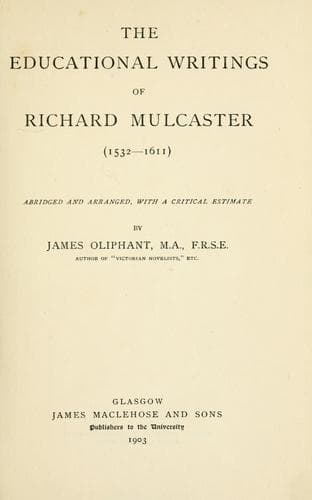
The Educational Writings of Richard MulcasterMulcaster, Richard
History
The Educational Writings of Richard Mulcaster
Mulcaster, Richard
Education -- History
As for my style in treatment, if it be charged with difficulty,
that also proceeds from choice, being intended to show that I
come from the forge, being always familiar with strong steel
and pithy stuff in the reading of good writers, and therefore
bound to resemble that metal in my style. To argue closely and
with sequence, to trace causes and effects, to seek sinews and
sound strength rather than waste flesh, is seemly for a student,
especially when he writes for perpetuity, where the reader may
keep the book by him to study at his leisure, not being forced
either to take it all at once or forgo it altogether, as is the
case in speech. Discourses that are entirely popular, or are
written in haste for the moment, may well be slight in manner, for
their life is short; and where what is said is at once to be put
to present use, the plainer the style the more plausible it will
be, and therefore most excellent in its kind, since the expression
must be adapted to the immediate end in view, leaving nothing to
muse on, as there is no time for musing. But where the matter is
no courier to post away in haste, and there must be musing on
it, another course must be taken, and yet the manner of delivery
must not be thought hard, nor compared with others of a different
kind, considering that it is meant to teach, and can use such
plainness only as the subject admits of. Does any man of judgment
in learning and in the Latin tongue think that Cicero’s orations
and his discourses in philosophy were equally well known and of
equal plainness to the people of Rome, though both in their own
way are plain enough to us, who know the Latin tongue better than
our own, because we pore over it, and pay no attention to our own?
Certainly not, as appears from many passages in Cicero himself,
where he notes the difference, and confesses that the newness of
the subjects which he transported from Greece was the cause of
some darkness to the ordinary reader, and of some contempt to the
learned because they fancied the Greek more. Yet neither ignorance
nor contempt could discourage his pen from seeking the advantage
of his own language, by translating into it the learning which
others wished to remain in the Greek; he kept on his course, and
in the end the tide turned in his favour, bringing him the credit
which he enjoys to this day. And he himself bears witness that
the resistance he met with was due not only to the matter of which
he treated, but also to his manner of expression, and even to the
very words he used, which being strange and newly-coined were
not understood by the ordinary reader. “I could write of these
things,” he says, meaning philosophical subjects, “like Amasanius”
(an obscure writer of apophthegms) “but in that case not like
myself; as plainly as he, but not then so as to satisfy myself, or
do justice to the subject as I should handle it. I must define,
divide, distinguish, exercise judgment, and use the terms of art.
Public-domain text, read in full here on John Shaqi.
Reviews
Reviews
No reviews yet
Be the first to share your thoughts on this work.
Elsewhere in the archive
Join the Discussion
Join the discussion
Sign in to leave a comment or review.
Sign InorCreate an account