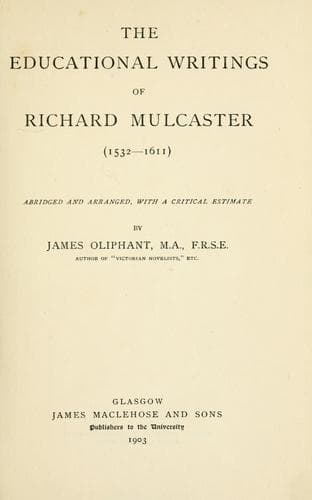
The Educational Writings of Richard MulcasterMulcaster, Richard
History
The Educational Writings of Richard Mulcaster
Mulcaster, Richard
Education -- History
As for the general writing in the English tongue, I must needs
say that for some points of handling there is no language more
excellent than ours. For teaching memory work pleasantly, as in the
old leonine verses, which run in rhyme, it admits more dalliance
with words than any other tongue I know. In firmness of speech and
strong ending it is very forcible, because of the monosyllabic
words of which it so largely consists. For fine translation in
pithy terms I find it as quick as any foreign tongue, or quicker,
as it is wonderfully pliable and ready to express a pointed thought
in very few words. For apt expression of a good deal of matter in
not many words it will do as much in original utterance as in any
translation. This compact expression may sometimes seem hard, but
only where ignorance is harboured, or where indolence is an idol,
which will not be persuaded to crack the nut, though it covet the
kernel. I need give no example of these, as my own writing will
serve as a general pattern. No one can judge so well of these
points in our tongue as those who find matter flowing from their
pen which refuses to be expressed in any other form. For our tongue
has a special character as well as every other, and cannot be
surpassed for grace and pith.
In regard to the force of words, which was the third note of
alleged obscurity, there are to be considered _familiarity_ for
the general reader, _beauty_ for the learned, _effectiveness_ to
give pleasure, and _borrowing_ to extend our resources and admit
of ready expression. Therefore, if any reader find fault with a
word which does not suit his ear, let him mark the one he knows,
and learn to value the other, which is worth his knowing. Do we not
learn from words? No marvel if it is so, for a word is a metaphor,
a learned translation, something carried over from its original
sense to serve in some place where it is even more properly used,
and where it may be most significant, if it is properly understood.
Take pains to learn from it; you have there a means of gaining
knowledge. It is not commonly used as I am using it, but I trust
I am not abusing it, and it may be filling a more stately place
than any you have ever seen it in. Then mark that the place honours
the parson, and think well of good words, for though they may
be handled by ordinary, or even by foul lips, yet in a fairer
mouth, or under a finer pen, they may come to honour. It may be a
stranger, and yet no Turk, and though it were the word of an enemy,
yet a good thing is worth getting, even from a foe, as well by
the language of writers as by the spoil of soldiers. And when the
foreign word has yielded itself and been received into favour, it
is no longer foreign, though of foreign race, the property in it
having been altered. But he who will speak of words need not lack
them. However, in this place there is no further need of words,
to say either which are familiar, or beautiful, or effective, or
Public-domain text, read in full here on John Shaqi.
Reviews
Reviews
No reviews yet
Be the first to share your thoughts on this work.
Elsewhere in the archive
Join the Discussion
Join the discussion
Sign in to leave a comment or review.
Sign InorCreate an account