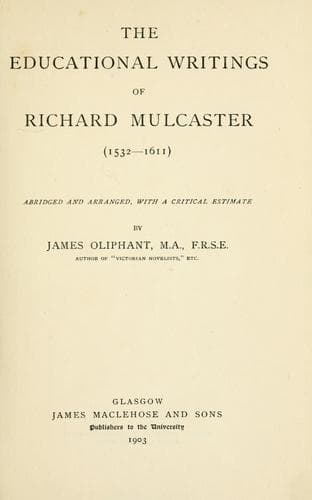
The Educational Writings of Richard MulcasterMulcaster, Richard
History
The Educational Writings of Richard Mulcaster
Mulcaster, Richard
Education -- History
which are borrowed; nor is there need to say that in regard to any
ornament in words we give place to no other tongue.
As for my own words and the terms that I use, they are generally
English, and if any be an incorporated stranger, or translated, or
freshly-coined, I have shaped it to fit the place where I use it,
as far as my skill will permit. The example and precept of the best
judges warrant us in enfranchising foreign words, or translating
our own without too manifest insolence or wanton affectation, or
else inventing new ones where they are clearly serviceable, the
context explaining them sufficiently till frequent usage has made
them well known. Therefore, to say what I mean in plain terms,
he who is soundly learned will straightway recognise a scholar;
he who is well acquainted with a strong pen, whether in reading
authors or in actual use, will soon master a compact style; he who
has skill in language, whether old and scholarly or newly received
into favour, will not wonder at words whose origin he knows, nor
be surprised at a thought tersely expressed, in a way familiar to
him in other languages. Therefore, as I fear not the judgment of
the skilful, because courtesy goes with knowledge, so I value their
friendship, because their support gives me credit.
As for those who lack the skill to judge rightly, though they may
be sharp censors and ready to talk loudly, I must crave their
pardon if I do not bow to their censure, which I cannot accept
as a true judgment. Yet I am content to bear with such fellows,
and pardon them their errors in regard to myself, as I trust that
those who can judge will in their courtesy pardon me my own errors.
Those who cannot judge rightly for want of knowledge, but will not
betray their weakness by judging wrongly, if they desire to learn
in any case of doubt, have the learned to give them counsel. The
profit is theirs, if they are willing to take it, but if not, they
shall not deter me from writing, and I shall hope at length by
deserving well to win their favour, or at least their silence. In
conclusion as to the manner of writing and use of words in English,
this is my opinion, that he who will justify himself may find many
arguments, some closely related to the particular subject that may
be in question, others more general but likely to be serviceable,
and if in his practice he hath due regard to clear and appropriate
expression, then even though one or two things should seem strange
to those who judge, the writer is free from blame. As for invention
in matter and eloquence in style, the learned know well in what
writers they are to be found, and those who are not scholars must
learn to think of such things before they presume to judge, lest
by failing to measure the writer’s level, they should have no
just standard to apply. As for the matter itself which is to be
treated by any learned method, as I have already said, familiarity
will make it easy, though it seem hard, just as it will make the
Public-domain text, read in full here on John Shaqi.
Reviews
Reviews
No reviews yet
Be the first to share your thoughts on this work.
Elsewhere in the archive
Join the Discussion
Join the discussion
Sign in to leave a comment or review.
Sign InorCreate an account