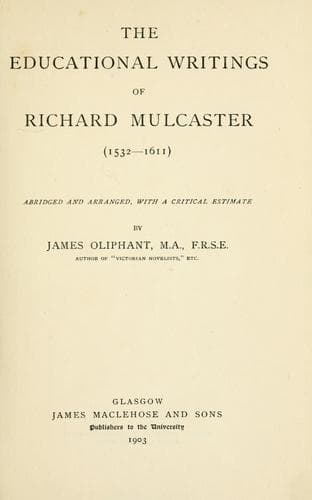
The Educational Writings of Richard MulcasterMulcaster, Richard
History
The Educational Writings of Richard Mulcaster
Mulcaster, Richard
Education -- History
If the saying of Plato may be applied to another sphere, not very
far removed from civil government, we may believe that education
will never be rightly practised until either teachers become
philosophers, or philosophers become teachers. It is certainly
remarkable how seldom in the history of educational progress there
has arisen any writer whose authority was based alike on the
power of the abstract thinker to rise above the conditions of the
immediate present into the atmosphere of pure reason, and on the
instinct of the professional worker, whose conceptions of what is
possible have been chastened by direct experience of the actual.
Of the five classical English writers who have made any noteworthy
contribution to educational thought, all but one have failed to
gain a lasting influence, through the limitation in their outlook
caused by deficient practical knowledge. Ascham’s experience was
too exclusively academic and courtly to suggest much to him beyond
questions of method in the advanced teaching of Latin and Greek.
Milton’s vision, restricted by his short and partial attempt at
instructing a few selected boys, narrowed itself to one school
period of one rank of society of one sex, and his genius could not
save him from wild extravagance in his ideas of the acquirements
possible for the average scholar. The suggestions of Locke, while
in one aspect they were more comprehensive, are yet essentially
those of a theorist, who had never faced the difficulty that the
upbringing of a child by a private tutor is possible only to the
merest fraction of any population. Herbert Spencer, as the heir
of previous centuries, has naturally been able to command a wider
view, but even those who have gained most from his book, must
have felt that owing to his highly generalised mode of treatment
he has at many points failed to grapple with the problems that
chiefly beset the professional teacher. A little experience, like
a little knowledge, is a dangerous thing, and it may be that
those writers, all of whom claim to have made trial of the actual
work of education, would have been more convincing if they had
written from an avowedly detached standpoint. Richard Mulcaster
alone holds the vantage-ground of being at once a thinker and a
practical expert in matters of education. Nor does this mean only
that his right to speak with authority will for that reason be more
readily admitted; the evidence of his fuller equipment for the
task may be seen through the whole texture of his writings. He had
not Ascham’s ease in expression and charm of manner, nor Milton’s
commanding intellect and power of utterance, nor the fearlessness
and philosophic grasp of Locke, nor the encyclopædic knowledge and
acumen of Herbert Spencer, but he had beyond them all two essential
gifts that will in the end give him a unique place in the history
of our educational development--a clear insight into the realities
of human nature, and an enlightened perception of the conditions
Public-domain text, read in full here on John Shaqi.
Reviews
Reviews
No reviews yet
Be the first to share your thoughts on this work.
Elsewhere in the archive
Join the Discussion
Join the discussion
Sign in to leave a comment or review.
Sign InorCreate an account