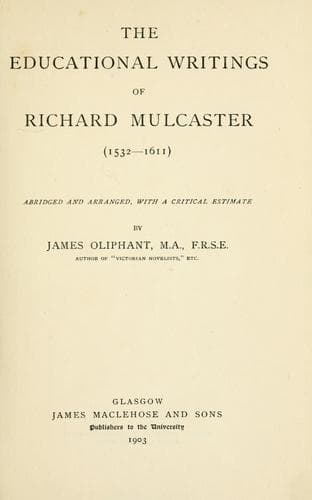
The Educational Writings of Richard MulcasterMulcaster, Richard
History
The Educational Writings of Richard Mulcaster
Mulcaster, Richard
Education -- History
that determine the culture of mind and soul.
To those who know little or nothing of Mulcaster such a claim
will seem extravagant, and it will naturally be doubted whether
any writer who deserves to be put upon so high a pedestal, could
possibly have remained so long in neglect. It may be rejoined that
in a subject like education many factors have a part in the making
of reputations. It is no mere coincidence that the authors named
above, whose views on education are so much more widely-known than
those of Mulcaster, all gained their chief fame in some other
sphere of thought; we read what they have to say on this subject
because it comes from writers who have caught the world’s ear in
some field of more general interest. This advantage is naturally
to be associated with gifts of expression such as Mulcaster
unfortunately possessed only in a very limited degree, though
his deficiency is due much more to the rudimentary condition of
English prose in general in the sixteenth century, than to any
lack of clear thinking on his own part. It is true, indeed, that
no fine sense of harmony in sound can be credited to a writer
who perpetrates such a sentence as--“I say no more, where it is
too much to say even so much in a sore of too much.” But even if
Mulcaster had spoken with the tongue of an angel, he would probably
have remained a voice crying in the wilderness, for the time was
not yet come. The ultimate value of Rousseau’s message to the world
in the realm of education was far less, but his unique powers of
persuasive eloquence, the fame he had achieved in other ways, and
the ripeness of the time, combined to give the later writer an
extraordinary influence. When Mulcaster’s judgments and suggestions
are studied from the vantage-ground of the present, and in a form
that divests them of adventitious difficulties of understanding,
they will be recognised as giving him a place of high importance,
not only in the chain of historical succession, but in the final
hierarchy of educational reformers.
Public-domain text, read in full here on John Shaqi.
Reviews
Reviews
No reviews yet
Be the first to share your thoughts on this work.
Elsewhere in the archive
Join the Discussion
Join the discussion
Sign in to leave a comment or review.
Sign InorCreate an account