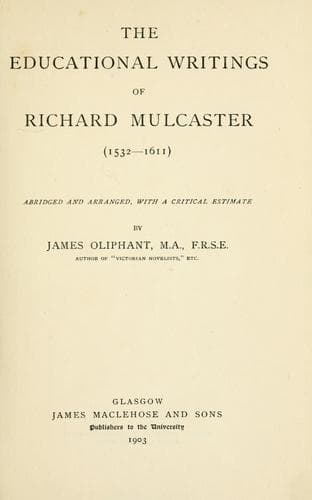
The Educational Writings of Richard MulcasterMulcaster, Richard
History
The Educational Writings of Richard Mulcaster
Mulcaster, Richard
Education -- History
Apart from the influence of an atmosphere of general conformity
to established authority and prevailing sentiment, Mulcaster was
constitutionally cautious. He was no zealot, defiant of opposition,
and careless of the esteem in which he might be held. His respect
for tradition, and, it must be added, his sympathetic instincts,
disposed him always to seek grounds of agreement rather than of
difference, to support his suggestions by the weight of authority
and precedent, to carry his readers with him by winning their
consent unawares rather than by startling them into reluctant
acquiescence through the use of paradox and exaggeration. Yet
there was no timidity or half-heartedness in his temperament. He
was profoundly convinced of the justice of his criticisms and the
value of his proposals, and he was not backward in urging his
views, in season at least if not out of season, on all who shared
the responsibility of rejecting them or giving them effect. He has
been accused, indeed, of overweening self-conceit, and it is to be
feared that this is the only persistent impression of the man that
remains with a number of those who know little of him beyond his
name. He has been cited as a classical example of the folly into
which a misplaced vanity can lead one who enters with a light heart
into the region of prophecy, that “most gratuitous form of error,”
on the ground that he believed the highest possible perfection of
English prose to be represented by the style of his own writings.
This conception, however, is due to a misunderstanding which it
will be worth while to remove. The remark that is quoted against
him occurs in the Peroration of the _Elementary_, “I need no
example in any of these, whereof mine own penning is a general
pattern.” Taken apart from the context, as it usually is, such
a sentence sounds fatuous enough, being naturally understood to
mean that Mulcaster thought he had nothing to learn from any
other writers, and had himself devised a perfect model of English
composition. But anyone who will take the trouble to read the
whole passage (p. 201) will see at once that the statement really
means, “I need give no example of any of these [idiosyncrasies
of our language, especially compactness of expression], as they
are sufficiently illustrated in my own writing.” This is a very
different matter, and though Mulcaster had little sense of style,
and was curiously mistaken in his idea that English prose had
no greater heights to reach than the standard of his own time,
the error was due to defects of literary taste and judgment, not
of character or temper. When his writings are taken as a whole,
they offer ample evidence that he was singularly modest in his
pretensions, losing all self-consciousness in his enthusiasm for
the causes he had at heart.
Public-domain text, read in full here on John Shaqi.
Reviews
Reviews
No reviews yet
Be the first to share your thoughts on this work.
Elsewhere in the archive
Join the Discussion
Join the discussion
Sign in to leave a comment or review.
Sign InorCreate an account