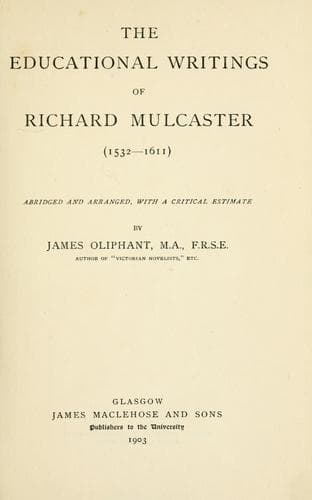
The Educational Writings of Richard MulcasterMulcaster, Richard
History
The Educational Writings of Richard Mulcaster
Mulcaster, Richard
Education -- History
This attitude may account for the disposition in some quarters to
deny Mulcaster any special originality in regard to his leading
principles. But in a subject like education, which concerns so many
departments of life and character, what is the precise meaning of
originality? As the essential traits of human nature have remained
unaltered in the last two or three thousand years, except for a
slow development along lines in continuity with the past, it is
vain to expect that the broader truths which underlie the arts of
social improvement will be subject to any radical change. In such
matters we must build on the wisdom of the ancients, and the only
possible originality consists in discerning the new applications
that are suited to the present time and place. It is safe to say
that there is hardly a single educational doctrine that has ever
won acceptance, the germs of which are not to be found in the
writings of Plato and Aristotle. Yet every age and every country
must work out its own salvation by choosing, combining, and
applying to its needs the general principles that have been laid
down by those that came before. Such eclecticism, if it cannot
strictly be called originality, is at least the highest wisdom,
and he who first proclaims the doctrine as true for his own time
and place deserves the credit of the pioneer. The discoveries of
the Greek philosophers in social politics, if discoveries they
could be called, had to be made over again for the modern world,
and it may even be said that they had to be made independently for
each separate country. In the sixteenth century there was less
uniformity in political and social conditions, and less mutual
influence among the different States of Europe than there is now.
Although the English nation under Elizabeth could not remain wholly
unaffected by the more drastic changes of opinion and sentiment
that marked the course of the reforming spirit in Germany and in
Scotland, it certainly demanded a rare sagacity and independence
of mind, if not absolute originality, to discern how far the new
outlook could be shared by those whose experience had been less
revolutionary. To understand the value of Mulcaster’s work it is of
less moment to ask what may have been his indebtedness to Plato or
Quintilian, or even to Luther and Knox, than to consider whether
he had been directly anticipated by any of his own countrymen, and
whether he himself anticipated, if he did not influence, later
English writers on education.
Public-domain text, read in full here on John Shaqi.
Reviews
Reviews
No reviews yet
Be the first to share your thoughts on this work.
Elsewhere in the archive
Join the Discussion
Join the discussion
Sign in to leave a comment or review.
Sign InorCreate an account