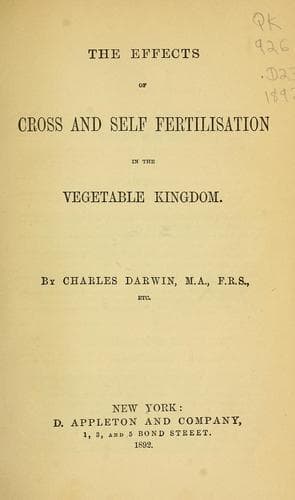
The Effects of Cross & Self-Fertilisation in the Vegetable KingdomDarwin, Charles
Science
The Effects of Cross & Self-Fertilisation in the Vegetable Kingdom
Darwin, Charles
Fertilization of plants; Plants -- Variation; Pollination
The average height of the eight crossed plants is here 25.92, and that
of the eight self-fertilised plants 23.54 inches; or as 100 to 90.
9. VIOLACEAE.--Viola tricolor.
Whilst the flowers of the common cultivated heartsease are young, the
anthers shed their pollen into a little semi-cylindrical passage, formed
by the basal portion of the lower petal, and surrounded by papillae. The
pollen thus collected lies close beneath the stigma, but can seldom gain
access into its cavity, except by the aid of insects, which pass their
proboscides down this passage into the nectary. (4/5. The flowers of
this plant have been fully described by Sprengel, Hildebrand, Delpino,
and H. Muller. The latter author sums up all the previous observations
in his ‘Befruchtung der Blumen’ and in ‘Nature’ November 20, 1873 page
44. See also Mr. A.W. Bennett in ‘Nature’ May 15, 1873 page 50 and some
remarks by Mr. Kitchener ibid page 143. The facts which follow on the
effects of covering up a plant of V. tricolor have been quoted by Sir J.
Lubbock in his ‘British Wild Flowers’ etc. page 62.) Consequently when I
covered up a large plant of a cultivated variety, it set only eighteen
capsules, and most of these contained very few good seeds--several from
only one to three; whereas an equally fine uncovered plant of the same
variety, growing close by, produced 105 fine capsules. The few flowers
which produce capsules when insects are excluded, are perhaps fertilised
by the curling inwards of the petals as their wither, for by this means
pollen-grains adhering to the papillae might be inserted into the cavity
of the stigma. But it is more probable that their fertilisation is
effected, as Mr. Bennett suggests, by Thrips and certain minute beetles
which haunt the flowers, and which cannot be excluded by any net.
Humble-bees are the usual fertilisers; but I have more than once seen
flies (Rhingia rostrata) at work, with the under sides of their bodies,
heads and legs dusted with pollen; and having marked the flowers which
they visited, I found them after a few days fertilised. (4/6. I should
add that this fly apparently did not suck the nectar, but was attracted
by the papillae which surround the stigma. Hermann Muller also saw a
small bee, an Andrena, which could not reach the nectar, repeatedly
inserting its proboscis beneath the stigma, where the papillae are
situated; so that these papillae must be in some way attractive to
insects. A writer asserts ‘Zoologist’ volume 3-4 page 1225, that a moth
(Plusia) frequently visits the flowers of the pansy. Hive-bees do not
ordinarily visit them, but a case has been recorded ‘Gardeners’
Chronicle’ 1844 page 374, of these bees doing so. Hermann Muller has
also seen the hive-bee at work, but only on the wild small-flowered
form. He gives a list ‘Nature’ 1873 page 45, of all the insects which he
has seen visiting both the large and small-flowered forms. From his
account, I suspect that the flowers of plants in a state of nature are
Public-domain text, read in full here on John Shaqi.
Reviews
Reviews
No reviews yet
Be the first to share your thoughts on this work.
Elsewhere in the archive
Join the Discussion
Join the discussion
Sign in to leave a comment or review.
Sign InorCreate an account