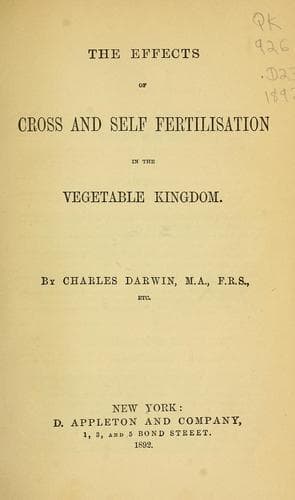
The Effects of Cross & Self-Fertilisation in the Vegetable KingdomDarwin, Charles
Science
The Effects of Cross & Self-Fertilisation in the Vegetable Kingdom
Darwin, Charles
Fertilization of plants; Plants -- Variation; Pollination
visited more frequently by insects than those of the cultivated
varieties. He has seen several butterflies sucking the flowers of wild
plants, and this I have never observed in gardens, though I have watched
the flowers during many years.) It is curious for how long a time the
flowers of the heartsease and of some other plants may be watched
without an insect being seen to visit them. During the summer of 1841, I
observed many times daily for more than a fortnight some large clumps of
heartsease growing in my garden, before I saw a single humble-bee at
work. During another summer I did the same, but at last saw some
dark-coloured humble-bees visiting on three successive days almost every
flower in several clumps; and almost all these flowers quickly withered
and produced fine capsules. I presume that a certain state of the
atmosphere is necessary for the secretion of nectar, and that as soon as
this occurs the insects discover the fact by the odour emitted, and
immediately frequent the flowers.
As the flowers require the aid of insects for their complete
fertilisation, and as they are not visited by insects nearly so often as
most other nectar-secreting flowers, we can understand the remarkable
fact discovered by H. Muller and described by him in ‘Nature,’ namely,
that this species exists under two forms. One of these bears conspicuous
flowers, which, as we have seen, require the aid of insects, and are
adapted to be cross-fertilised by them; whilst the other form has much
smaller and less conspicuously coloured flowers, which are constructed
on a slightly different plan, favouring self-fertilisation, and are thus
adapted to ensure the propagation of the species. The self-fertile form,
however, is occasionally visited, and may be crossed by insects, though
this is rather doubtful.
In my first experiments on Viola tricolor I was unsuccessful in raising
seedlings, and obtained only one full-grown crossed and self-fertilised
plant. The former was 12 1/2 inches and the latter 8 inches in height.
On the following year several flowers on a fresh plant were crossed with
pollen from another plant, which was known to be a distinct seedling;
and to this point it is important to attend. Several other flowers on
the same plant were fertilised with their own pollen. The average number
of seeds in the ten crossed capsules was 18.7, and in the twelve
self-fertilised capsules 12.83; or as 100 to 69. These seeds, after
germinating on bare sand, were planted in pairs on the opposite sides of
five pots. They were first measured when about a third of their full
size, and the crossed plants then averaged 3.87 inches, and the
self-fertilised only 2.00 inches in height; or as 100 to 52. They were
kept in the greenhouse, and did not grow vigorously. Whilst in flower
they were again measured to the summits of their stems (see Table 4/41),
with the following result:--
TABLE 4/41. Viola tricolor.
Heights of plants measured in inches.
Column 1: Number (Name) of Pot.
Public-domain text, read in full here on John Shaqi.
Reviews
Reviews
No reviews yet
Be the first to share your thoughts on this work.
Elsewhere in the archive
Join the Discussion
Join the discussion
Sign in to leave a comment or review.
Sign InorCreate an account