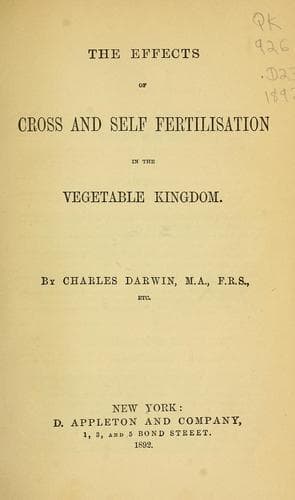
The Effects of Cross & Self-Fertilisation in the Vegetable KingdomDarwin, Charles
Science
The Effects of Cross & Self-Fertilisation in the Vegetable Kingdom
Darwin, Charles
Fertilization of plants; Plants -- Variation; Pollination
We thus see how greatly the offspring from the self-fertilised plants of
the third generation crossed by a fresh stock, had their fertility
increased, whether tested by the number of capsules produced or by the
weight of the contained seeds; this latter being the more trustworthy
method. Even the offspring from the self-fertilised plants crossed by
one of the crossed plants of the same stock, notwithstanding that both
lots had been long subjected to the same conditions, had their fertility
considerably increased, as tested by the same two methods.
In conclusion it may be well to repeat in reference to the fertility of
these three lots of plants, that their flowers were left freely exposed
to the visits of insects and were undoubtedly crossed by them, as may be
inferred from the large number of good capsules produced. These plants
were all the offspring of the same mother-plants, and the strongly
marked difference in their fertility must be attributed to the nature of
the pollen employed in fertilising their parents; and the difference in
the nature of the pollen must be attributed to the different treatment
to which the pollen-bearing parents had been subjected during several
previous generations.
COLOUR OF THE FLOWERS.
The flowers produced by the self-fertilised plants of the last or fourth
generation were as uniform in tint as those of a wild species, being of
a pale pink or rose colour. Analogous cases with Mimulus and Ipomoea,
after several generations of self-fertilisation, have been already
given. The flowers of the intercrossed plants of the fourth generation
were likewise nearly uniform in colour. On the other hand, the flowers
of the London-crossed plants, or those raised from a cross with the
fresh stock which bore dark crimson flowers, varied extremely in colour,
as might have been expected, and as is the general rule with seedling
carnations. It deserves notice that only two or three of the
London-crossed plants produced dark crimson flowers like those of their
fathers, and only a very few of a pale pink like those of their mothers.
The great majority had their petals longitudinally and variously striped
with the two colours,--the groundwork tint being, however, in some cases
darker than that of the mother-plants.
12. MALVACEAE.--Hibiscus africanus.
Many flowers on this Hibiscus were crossed with pollen from a distinct
plant, and many others were self-fertilised. A rather larger
proportional number of the crossed than of the self-fertilised flowers
yielded capsules, and the crossed capsules contained rather more seeds.
The self-fertilised seeds were a little heavier than an equal number of
the crossed seeds, but they germinated badly, and I raised only four
plants of each lot. In three out of the four pots, the crossed plants
flowered first.
TABLE 4/48. Hibiscus africanus.
Heights of plants measured in inches.
Column 1: Number (Name) of Pot.
Column 2: Crossed Plants.
Column 3: Self-fertilised Plants.
Public-domain text, read in full here on John Shaqi.
Reviews
Reviews
No reviews yet
Be the first to share your thoughts on this work.
Elsewhere in the archive
Join the Discussion
Join the discussion
Sign in to leave a comment or review.
Sign InorCreate an account