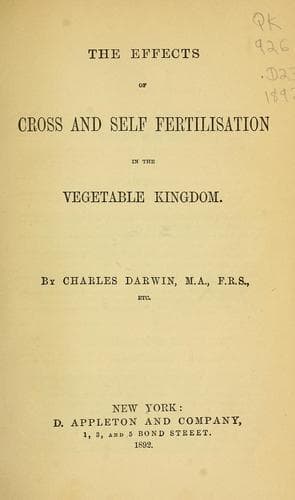
The Effects of Cross & Self-Fertilisation in the Vegetable KingdomDarwin, Charles
Science
The Effects of Cross & Self-Fertilisation in the Vegetable Kingdom
Darwin, Charles
Fertilization of plants; Plants -- Variation; Pollination
Pot 1 : 13 4/8 : 16 2/8.
Pot 2 : 14 : 14.
Pot 3 : 8 : 7.
Pot 4 : 17 4/8 : 20 4/8.
Total : 53.00 : 57.75.
The four crossed plants average 13.25, and the four self-fertilised
14.43 inches in height; or as 100 to 109. Here we have the unusual case
of self-fertilised plants exceeding the crossed in height; but only four
pairs were measured, and these did not grow well or equally. I did not
compare the fertility of the two lots.
CHAPTER V.
GERANIACEAE, LEGUMINOSAE, ONAGRACEAE, ETC.
Pelargonium zonale, a cross between plants propagated by cuttings does
no good.
Tropaeolum minus.
Limnanthes douglasii.
Lupinus luteus and pilosus.
Phaseolus multiflorus and vulgaris.
Lathyrus odoratus, varieties of, never naturally intercross in England.
Pisum sativum, varieties of, rarely intercross, but a cross between them
highly beneficial.
Sarothamnus scoparius, wonderful effects of a cross.
Ononis minutissima, cleistogene flowers of.
Summary on the Leguminosae.
Clarkia elegans.
Bartonia aurea.
Passiflora gracilis.
Apium petroselinum.
Scabiosa atropurpurea.
Lactuca sativa.
Specularia speculum.
Lobelia ramosa, advantages of a cross during two generations.
Lobelia fulgens.
Nemophila insignis, great advantages of a cross.
Borago officinalis.
Nolana prostrata.
13. GERANIACEAE.--Pelargonium zonale.
This plant, as a general rule, is strongly proterandrous, and is
therefore adapted for cross-fertilisation by the aid of insects. (5/1.
Mr. J. Denny, a great raiser of new varieties of pelargoniums, after
stating that this species is proterandrous, adds ‘The Florist and
Pomologist’ January 1872 page 11, “there are some varieties, especially
those with petals of a pink colour, or which possess a weakly
constitution, where the pistil expands as soon as or even before the
pollen-bag bursts, and in which also the pistil is frequently short, so
when it expands it is smothered as it were by the bursting anthers;
these varieties are great seeders, each pip being fertilised by its own
pollen. I would instance Christine as an example of this fact.” We have
here an interesting case of variability in an important functional
point.) Some flowers on a common scarlet variety were self-fertilised,
and other flowers were crossed with pollen from another plant; but no
sooner had I done so, than I remembered that these plants had been
propagated by cuttings from the same stock, and were therefore parts in
a strict sense of the same individual. Nevertheless, having made the
cross I resolved to save the seeds, which, after germinating on sand,
were planted on the opposite sides of three pots. In one pot the
quasi-crossed plant was very soon and ever afterwards taller and finer
than the self-fertilised. In the two other pots the seedlings on both
sides were for a time exactly equal; but when the self-fertilised plants
were about 10 inches in height, they surpassed their antagonists by a
little, and ever afterwards showed a more decided and increasing
Public-domain text, read in full here on John Shaqi.
Reviews
Reviews
No reviews yet
Be the first to share your thoughts on this work.
Elsewhere in the archive
Join the Discussion
Join the discussion
Sign in to leave a comment or review.
Sign InorCreate an account