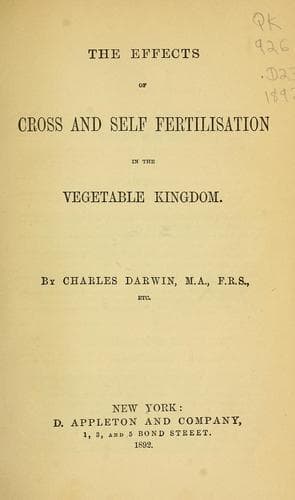
The Effects of Cross & Self-Fertilisation in the Vegetable KingdomDarwin, Charles
Science
The Effects of Cross & Self-Fertilisation in the Vegetable Kingdom
Darwin, Charles
Fertilization of plants; Plants -- Variation; Pollination
From crossed and self-fertilised seeds obtained in the manner just
described, I succeeded in raising to maturity only a pair of plants,
which were kept in a pot in the greenhouse. The crossed plant grew to a
height of 33 inches, and the self-fertilised to that of 26 1/2 inches.
The former produced, whilst still kept in the greenhouse, eight pods,
containing on an average 2.77 seeds; and the latter only two pods,
containing on an average 2.5 seeds. The average height of the two
crossed plants of the two generations taken together was 35.5, and that
of the three self-fertilised plants of the same two generations 30.5; or
as 100 to 86. (5/3. We here see that both Lupinus luteus and pilosus
seed freely when insects are excluded; but Mr. Swale, of Christchurch,
in New Zealand, informs me ‘Gardeners’ Chronicle’ 1858 page 828, that
the garden varieties of the lupine are not there visited by any bees,
and that they seed less freely than any other introduced leguminous
plant, with the exception of red clover. He adds “I have, for amusement,
during the summer, released the stamens with a pin, and a pod of seed
has always rewarded me for my trouble, the adjoining flowers not so
served having all proved blind.” I do not know to what species this
statement refers.)
Phaseolus multiflorus.
This plant, the scarlet-runner of English gardeners and the Phaseolus
coccineus of Lamarck, originally came from Mexico, as I am informed by
Mr. Bentham. The flowers are so constructed that hive and humble-bees,
which visit them incessantly, almost always alight on the left
wing-petal, as they can best suck the nectar from this side. Their
weight and movements depress the petal, and this causes the stigma to
protrude from the spirally-wound keel, and a brush of hairs round the
stigma pushes out the pollen before it. The pollen adheres to the head
or proboscis of the bee which is at work, and is thus placed either on
the stigma of the same flower, or is carried to another flower. (5/4.
The flowers have been described by Delpino, and in an admirable manner
by Mr. Farrer in the ‘Annals and Magazine of Natural History’ volume 2
4th series October 1868 page 256. My son Francis has explained ‘Nature’
January 8, 1874 page 189, the use of one peculiarity in their structure,
namely, a little vertical projection on the single free stamen near its
base, which seems placed as if to guard the entrance into the two
nectar-holes in the staminal sheath. He shows that this projection
prevents the bees reaching the nectar, unless they go to the left side
of the flower, and it is absolutely necessary for cross-fertilisation
that they should alight on the left wing-petal.) Several years ago I
covered some plants under a large net, and these produced on one
occasion about one-third, and on another occasion about one-eighth, of
the number of pods which the same number of uncovered plants growing
close alongside produced. (5/5. ‘Gardeners’ Chronicle’ 1857 page 725 and
Public-domain text, read in full here on John Shaqi.
Reviews
Reviews
No reviews yet
Be the first to share your thoughts on this work.
Elsewhere in the archive
Join the Discussion
Join the discussion
Sign in to leave a comment or review.
Sign InorCreate an account