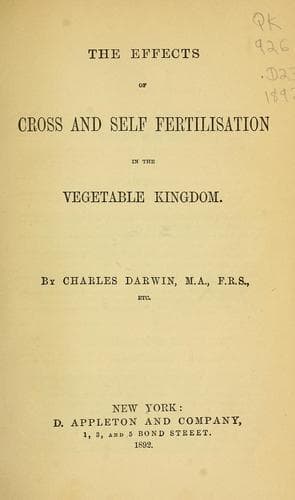
The Effects of Cross & Self-Fertilisation in the Vegetable KingdomDarwin, Charles
Science
The Effects of Cross & Self-Fertilisation in the Vegetable Kingdom
Darwin, Charles
Fertilization of plants; Plants -- Variation; Pollination
more especially ibid 1858 page 828. Also ‘Annals and Magazine of Natural
History’ 3rd series volume 2 1858 page 462.) This lessened fertility was
not caused by any injury from the net, as I moved the wing-petals of
several protected flowers, in the same manner as bees do, and these
produced remarkably fine pods. When the net was taken off, the flowers
were immediately visited by bees, and it was interesting to observe how
quickly the plants became covered with young pods. As the flowers are
much frequented by Thrips, the self-fertilisation of most of the flowers
under the net may have been due to the action of these minute insects.
Dr. Ogle likewise covered up a large portion of a plant, and “out of a
vast number of blossoms thus protected not a single one produced a pod,
while the unprotected blossoms were for the most part fruitful.” Mr.
Belt gives a more curious case; this plant grows well and flowers in
Nicaragua; but as none of the native bees visit the flowers, not a
single pod is ever produced. (5/6. Dr. Ogle ‘Popular Science Review’
1870 page 168. Mr. Belt ‘The Naturalist in Nicaragua’ 1874 page 70. The
latter author gives a case ‘Nature’ 1875 page 26, of a late crop of
Phaseolus multiflorus near London which “was rendered barren” by the
humble-bees cutting, as they frequently do, holes at the bases of the
flowers instead of entering them in the proper manner.)
From the facts now given we may feel nearly sure that individuals of the
same variety or of different varieties, if growing near each other and
in flower at the same time, would intercross; but I cannot myself
advance any direct evidence of such an occurrence, as only a single
variety is commonly cultivated in England. I have, however, received an
account from the Reverend W.A. Leighton, that plants raised by him from
ordinary seed produced seeds differing in an extraordinary manner in
colour and shape, leading to the belief that their parents must have
been crossed. In France M. Fermond more than once planted close together
varieties which ordinarily come true and which bear differently coloured
flowers and seeds; and the offspring thus raised varied so greatly that
there could hardly be a doubt that they had intercrossed. (5/7.
‘Fécondation chez les Végétaux’ 1859 pages 34-40. He adds that M.
Villiers has described a spontaneous hybrid, which he calls Phaseolus
coccineus hybridus, in the ‘Annales de la Soc. R. de Horticulture’ June
1844.) On the other hand, Professor H. Hoffman does not believe in the
natural crossing of the varieties; for although seedlings raised from
two varieties growing close together produced plants which yielded seeds
of a mixed character, he found that this likewise occurred with plants
separated by a space of from 40 to 150 paces from any other variety; he
therefore attributes the mixed character of the seed to spontaneous
variability. (5/8. ‘Bestimmung des Werthes von Species und Varietat’
Public-domain text, read in full here on John Shaqi.
Reviews
Reviews
No reviews yet
Be the first to share your thoughts on this work.
Elsewhere in the archive
Join the Discussion
Join the discussion
Sign in to leave a comment or review.
Sign InorCreate an account