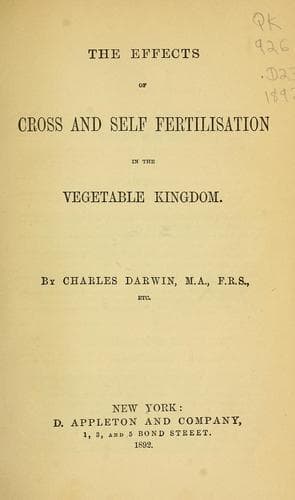
The Effects of Cross & Self-Fertilisation in the Vegetable KingdomDarwin, Charles
Science
The Effects of Cross & Self-Fertilisation in the Vegetable Kingdom
Darwin, Charles
Fertilization of plants; Plants -- Variation; Pollination
With respect to this species, I merely ascertained that the flowers were
highly fertile when insects were excluded, as indeed must be the case,
for the plants are often forced during the winter when no insects are
present. Some plants of two varieties (namely Canterbury and Fulmer’s
Forcing Bean) were covered with a net, and they seemed to produce as
many pods, containing as many beans, as some uncovered plants growing
alongside; but neither the pods nor the beans were actually counted.
This difference in self-fertility between Phaseolus vulgaris and
multifloris is remarkable, as these two species are so closely related
that Linnaeus thought that they formed one. When the varieties of
Phaseolus vulgaris grow near one another in the open ground, they
sometimes cross largely, notwithstanding their capacity for
self-fertilisation. Mr. Coe has given me a remarkable instance of this
fact with respect to the negro and a white-seeded and a brown-seeded
variety, which were all grown together. The diversity of character in
the seedlings of the second generation raised by me from his plants was
wonderful. I could add other analogous cases, and the fact is well-known
to gardeners. (5/10. I have given Mr. Coe’s case in the ‘Gardeners’
Chronicle’ 1858 page 829. See also for another case ibid page 845.)
Lathyrus odoratus.
Almost everyone who has studied the structure of papilionaceous flowers
has been convinced that they are specially adapted for
cross-fertilisation, although many of the species are likewise capable
of self-fertilisation. The case therefore of Lathyrus odoratus or the
sweet-pea is curious, for in this country it seems invariably to
fertilise itself. I conclude that this is so, as five varieties,
differing greatly in the colour of their flowers but in no other
respect, are commonly sold and come true; yet on inquiry from two great
raisers of seed for sale, I find that they take no precautions to insure
purity--the five varieties being habitually grown close together. (5/11.
See Mr. W. Earley in ‘Nature’ 1872 page 242, to the same effect. He
once, however, saw bees visiting the flowers, and supposed that on this
occasion they would have been intercrossed.) I have myself purposely
made similar trials with the same result. Although the varieties always
come true, yet, as we shall presently see, one of the five well-known
varieties occasionally gives birth to another, which exhibits all its
usual characters. Owing to this curious fact, and to the darker-coloured
varieties being the most productive, these increase, to the exclusion of
the others, as I was informed by the late Mr. Masters, if there be no
selection.
Public-domain text, read in full here on John Shaqi.
Reviews
Reviews
No reviews yet
Be the first to share your thoughts on this work.
Elsewhere in the archive
Join the Discussion
Join the discussion
Sign in to leave a comment or review.
Sign InorCreate an account