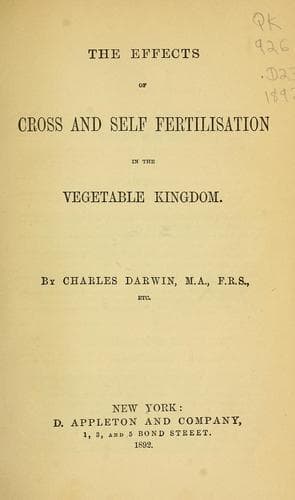
The Effects of Cross & Self-Fertilisation in the Vegetable KingdomDarwin, Charles
Science
The Effects of Cross & Self-Fertilisation in the Vegetable Kingdom
Darwin, Charles
Fertilization of plants; Plants -- Variation; Pollination
As no variability of this kind can be detected in plants raised from
seeds, the parents of which have grown during many successive
generations in close proximity, we may infer that they cannot have
intercrossed. What does occasionally occur is that in a row of plants
raised from seeds of one variety, another variety true of its kind
appears; for instance, in a long row of Scarlets (the seeds of which had
been carefully gathered from Scarlets for the sake of this experiment)
two Purples and one Painted Lady appeared. Seeds from these three
aberrant plants were saved and sown in separate beds. The seedlings from
both the Purples were chiefly Purples, but with some Painted Ladies and
some Scarlets. The seedlings from the aberrant Painted Lady were chiefly
Painted Ladies with some Scarlets. Each variety, whatever its parentage
may have been, retained all its characters perfect, and there was no
streaking or blotching of the colours, as in the foregoing plants of
crossed origin. Another variety, however, is often sold, which is
striped and blotched with dark purple; and this is probably of crossed
origin, for I found, as well as Mr. Masters, that it did not transmit
its characters at all truly.
From the evidence now given, we may conclude that the varieties of the
sweet-pea rarely or never intercross in this country; and this is a
highly remarkable fact, considering, firstly, the general structure of
the flowers; secondly, the large quantity of pollen produced, far more
than is requisite for self-fertilisation; and thirdly, the occasional
visit of insects. That insects should sometimes fail to cross-fertilise
the flowers is intelligible, for I have thrice seen humble-bees of two
kinds, as well as hive-bees, sucking the nectar, and they did not
depress the keel-petals so as to expose the anthers and stigma; they
were therefore quite inefficient for fertilising the flowers. One of
these bees, namely, Bombus lapidarius, stood on one side at the base of
the standard and inserted its proboscis beneath the single separate
stamen, as I afterwards ascertained by opening the flower and finding
this stamen prised up. Bees are forced to act in this manner from the
slit in the staminal tube being closely covered by the broad membranous
margin of the single stamen, and from the tube not being perforated by
nectar-passages. On the other hand, in the three British species of
Lathyrus which I have examined, and in the allied genus Vicia, two
nectar-passages are present. Therefore British bees might well be
puzzled how to act in the case of the sweet-pea. I may add that the
staminal tube of another exotic species, Lathyrus grandiflorus, is not
perforated by nectar-passages, and this species has rarely set any pods
in my garden, unless the wing-petals were moved up and down, in the same
manner as bees ought to do; and then pods were generally formed, but
from some cause often dropped off afterwards. One of my sons caught an
Public-domain text, read in full here on John Shaqi.
Reviews
Reviews
No reviews yet
Be the first to share your thoughts on this work.
Elsewhere in the archive
Join the Discussion
Join the discussion
Sign in to leave a comment or review.
Sign InorCreate an account