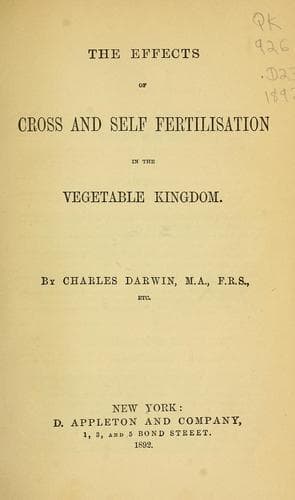
The Effects of Cross & Self-Fertilisation in the Vegetable KingdomDarwin, Charles
Science
The Effects of Cross & Self-Fertilisation in the Vegetable Kingdom
Darwin, Charles
Fertilization of plants; Plants -- Variation; Pollination
elephant sphinx-moth whilst visiting the flowers of the sweet-pea, but
this insect would not depress the wing-petals and keel. On the other
hand, I have seen on one occasion hive-bees, and two or three occasions
the Megachile willughbiella in the act of depressing the keel; and these
bees had the under sides of their bodies thickly covered with pollen,
and could not thus fail to carry pollen from one flower to the stigma of
another. Why then do not the varieties occasionally intercross, though
this would not often happen, as insects so rarely act in an efficient
manner? The fact cannot, as it appears, be explained by the flowers
being self-fertilised at a very early age; for although nectar is
sometimes secreted and pollen adheres to the viscid stigma before the
flowers are fully expanded, yet in five young flowers which were
examined by me the pollen-tubes were not exserted. Whatever the cause
may be, we may conclude, that in England the varieties never or very
rarely intercross. But it does not follow from this, that they would not
be cross by the aid of other and larger insects in their native country,
which in botanical works is said to be the south of Europe and the East
Indies. Accordingly I wrote to Professor Delpino, in Florence, and he
informs me “that it is the fixed opinion of gardeners there that the
varieties do intercross, and that they cannot be preserved pure unless
they are sown separately.”
It follows also from the foregoing facts that the several varieties of
the sweet-pea must have propagated themselves in England by
self-fertilisation for very many generations, since the time when each
new variety first appeared. From the analogy of the plants of Mimulus
and Ipomoea, which had been self-fertilised for several generations, and
from trials previously made with the common pea, which is in nearly the
same state as the sweet-pea, it appeared to me very improbable that a
cross between the individuals of the same variety would benefit the
offspring. A cross of this kind was therefore not tried, which I now
regret. But some flowers of the Painted Lady, castrated at an early age,
were fertilised with pollen from the Purple sweet-pea; and it should be
remembered that these varieties differ in nothing except in the colour
of their flowers. The cross was manifestly effectual (though only two
seeds were obtained), as was shown by the two seedlings, when they
flowered, closely resembling their father, the Purple pea, excepting
that they were a little lighter coloured, with their keels slightly
streaked with pale purple. Seeds from flowers spontaneously
self-fertilised under a net were at the same time saved from the same
mother-plant, the Painted Lady. These seeds unfortunately did not
germinate on sand at the same time with the crossed seeds, so that they
could not be planted simultaneously. One of the two crossed seeds in a
state of germination was planted in a pot (Number 1) in which a
Public-domain text, read in full here on John Shaqi.
Reviews
Reviews
No reviews yet
Be the first to share your thoughts on this work.
Elsewhere in the archive
Join the Discussion
Join the discussion
Sign in to leave a comment or review.
Sign InorCreate an account