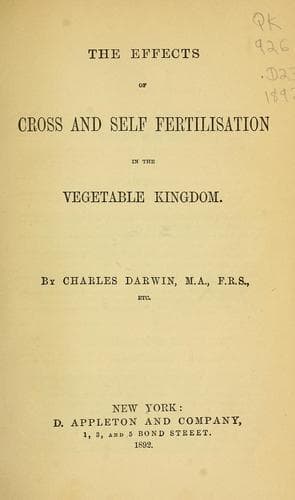
The Effects of Cross & Self-Fertilisation in the Vegetable KingdomDarwin, Charles
Science
The Effects of Cross & Self-Fertilisation in the Vegetable Kingdom
Darwin, Charles
Fertilization of plants; Plants -- Variation; Pollination
In the closely allied genus, Campanula, in which Specularia was formerly
included, the anthers shed at an early period their pollen, and this
adheres to the collecting hairs which surround the pistil beneath the
stigma; so that without some mechanical aid the flowers cannot be
fertilised. For instance, I covered up a plant of Campanula carpathica,
and it did not produce a single capsule, whilst the surrounding
uncovered plants seeded profusely. On the other hand, the present
species of Specularia appears to set almost as many capsules when
covered up, as when left to the visits of the Diptera, which, as far as
I have seen, are the only insects that frequent the flowers. (5/20. It
has long been known that another species of the genus, Specularia
perfoliata, produces cleistogene as well as perfect flowers, and the
former are of course self-fertile.) I did not ascertain whether the
naturally crossed and spontaneously self-fertilised capsules contained
an equal number of seeds, but a comparison of artificially crossed and
self-fertilised flowers, showed that the former were probably the most
productive. It appears that this plant is capable of producing a large
number of self-fertilised capsules owing to the petals closing at night,
as well as during cold weather. In the act of closing, the margins of
the petals become reflexed, and their inwardly projecting midribs then
pass between the clefts of the stigma, and in doing so push the pollen
from the outside of the pistil on to the stigmatic surfaces. (5/21. Mr.
Meehan has lately shown ‘Proceedings of the Academy of Natural Science
Philadelphia’ May 16, 1876 page 84, that the closing of the flowers of
Claytonia virginica and Ranunculus bulbosus during the night causes
their self-fertilisation.)
Twenty flowers were fertilised by me with their own pollen, but owing to
the bad season, only six capsules were produced; they contained on an
average 21.7 seeds, with a maximum of forty-eight in one. Fourteen
flowers were crossed with pollen from another plant, and these produced
twelve capsules, containing on an average 30 seeds, with a maximum in
one of fifty-seven seeds; so that the crossed seeds were to the
self-fertilised from an equal number of capsules as 100 to 72. The
former were also heavier than an equal number of self-fertilised seeds,
in the ratio of 100 to 86. Thus, whether we judge by the number of
capsules produced from an equal number of flowers, or by the average
number of the contained seeds, or the maximum number in any one capsule,
or by their weight, crossing does great good in comparison with
self-fertilisation. The two lots of seeds were sown on the opposite
sides of four pots; but the seedlings were not sufficiently thinned.
Only the tallest plant on each side was measured, when fully grown. The
measurements are given in Table 5/67. In all four pots the crossed
plants flowered first. When the seedlings were only about an inch and a
half in height both lots were equal.
Public-domain text, read in full here on John Shaqi.
Reviews
Reviews
No reviews yet
Be the first to share your thoughts on this work.
Elsewhere in the archive
Join the Discussion
Join the discussion
Sign in to leave a comment or review.
Sign InorCreate an account