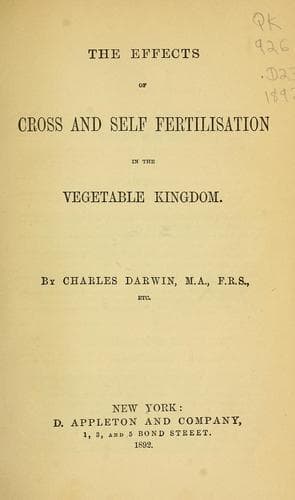
The Effects of Cross & Self-Fertilisation in the Vegetable KingdomDarwin, Charles
Science
The Effects of Cross & Self-Fertilisation in the Vegetable Kingdom
Darwin, Charles
Fertilization of plants; Plants -- Variation; Pollination
TABLE 5/67. Specularia speculum.
Heights of plants measured in inches.
Column 1: Number (Name) of Pot.
Column 2: Tallest Crossed Plant in each Pot.
Column 3: Tallest Self-fertilised Plant in each Pot.
Pot 1 : 18 : 15 6/8.
Pot 2 : 17 : 19.
Pot 3 : 22 1/8 : 18.
Pot 4 : 20 : 23.
Total : 77.13 : 75.75.
The four tallest crossed plants averaged 19.28, and the four tallest
self-fertilised 18.93 inches in height; or as 100 to 98. So that there
was no difference worth speaking of between the two lots in height;
though other great advantages are derived, as we have seen, from
cross-fertilisation. From being grown in pots and kept in the
greenhouse, none of the plants produced any capsules.
Lobelia ramosa. (5/22. I have adopted the name given to this plant in
the ‘Gardeners’ Chronicle’ 1866. Professor T. Dyer, however, informs me
that it probably is a white variety of L. tenuior of R. Brown, from W.
Australia.)
VAR. SNOW-FLAKE.
The well-adapted means by which cross-fertilisation is ensured in this
genus have been described by several authors. (5/23. See the works of
Hildebrand and Delpino. Mr. Farrer also has given a remarkably clear
description of the mechanism by which cross-fertilisation is effected in
this genus, in the ‘Annals and Magazine of Natural History’ volume 2 4th
series 1868 page 260. In the allied genus Isotoma, the curious spike
which projects rectangularly from the anthers, and which when shaken
causes the pollen to fall on the back of an entering insect, seems to
have been developed from a bristle, like one of those which spring from
the anthers in some of or all the species of Lobelia, as described by
Mr. Farrer.) The pistil as it slowly increases in length pushes the
pollen out of the conjoined anthers, by the aid of a ring of bristles;
the two lobes of the stigma being at this time closed and incapable of
fertilisation. The extrusion of the pollen is also aided by insects,
which rub against the little bristles that project from the anthers. The
pollen thus pushed out is carried by insects to the older flowers, in
which the stigma of the now freely projecting pistil is open and ready
to be fertilised. I proved the importance of the gaily-coloured corolla,
by cutting off the large flowers of Lobelia erinus; and these flowers
were neglected by the hive-bees which were incessantly visiting the
other flowers.
Public-domain text, read in full here on John Shaqi.
Reviews
Reviews
No reviews yet
Be the first to share your thoughts on this work.
Elsewhere in the archive
Join the Discussion
Join the discussion
Sign in to leave a comment or review.
Sign InorCreate an account