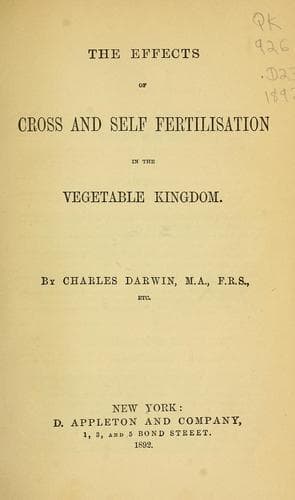
The Effects of Cross & Self-Fertilisation in the Vegetable KingdomDarwin, Charles
Science
The Effects of Cross & Self-Fertilisation in the Vegetable Kingdom
Darwin, Charles
Fertilization of plants; Plants -- Variation; Pollination
In the year 1868 eighteen flowers on a protected plant were crossed with
pollen from a distinct plant, but only seven of these produced fruit;
and I suspect that I applied pollen to many of the stigmas before they
were mature. These fruits contained on an average 2 seeds, with a
maximum in one of three seeds. Twenty-four spontaneously self-fertilised
fruits were produced by the same plant, and these contained on an
average 1.2 seeds, with a maximum of two in one fruit. So that the
fruits from the artificially crossed flowers yielded seeds compared with
those from the spontaneously self-fertilised flowers, in the ratio of
100 to 60. But the self-fertilised seeds, as often occurs when few are
produced, were heavier than the crossed seeds in the ratio of 100 to 90.
These two lots of seeds were sown on opposite sides of two large pots;
but I succeeded in raising only four pairs of equal age. When the
seedlings on both sides were about 8 inches in height they were equal.
When in full flower they were measured, as follows:--
TABLE 5/74. Borago officinalis.
Heights of plants measured in inches.
Column 1: Number (Name) of Pot.
Column 2: Crossed Plants.
Column 3: Self-fertilised Plants.
Pot 1 : 19 : 13 4/8.
Pot 1 : 21 : 18 6/8.
Pot 1 : 16 4/8 : 20 2/8.
Pot 2 : 26 2/8 : 32 2/8.
Total : 82.75 : 84.75.
The average height of the four crossed plants is here 20.68, and that of
the four self-fertilised 21.18 inches; or as 100 to 102. The
self-fertilised plants thus exceeded the crossed in height by a little;
but this was entirely due to the tallness of one of the self-fertilised.
The crossed plants in both pots flowered before the self-fertilised.
Therefore I believe if more plants had been raised, the result would
have been different. I regret that I did not attend to the fertility of
the two lots.
24. NOLANACEAE.--Nolana prostrata.
In some of the flowers the stamens are considerably shorter than the
pistil, in others equal to it in length. I suspected, therefore, but
erroneously as it proved, that this plant was dimorphic, like Primula,
Linum, etc., and in the year 1862 twelve plants, covered by a net in the
greenhouse, were subjected to trial. The spontaneously self-fertilised
flowers yielded 64 grains weight of seeds, but the product of fourteen
artificially crossed flowers is here included, which falsely increases
the weight of the self-fertilised seeds. Nine uncovered plants, the
flowers of which were eagerly visited by bees for their pollen and were
no doubt intercrossed by them, produced 79 grains weight of seeds:
therefore twelve plants thus treated would have yielded 105 grains. Thus
the seeds produced by the flowers on an equal number of plants, when
crossed by bees, and spontaneously self-fertilised (the product of
fourteen artificially crossed flowers being, however, included in the
latter) were in weight as 100 to 61.
Public-domain text, read in full here on John Shaqi.
Reviews
Reviews
No reviews yet
Be the first to share your thoughts on this work.
Elsewhere in the archive
Join the Discussion
Join the discussion
Sign in to leave a comment or review.
Sign InorCreate an account