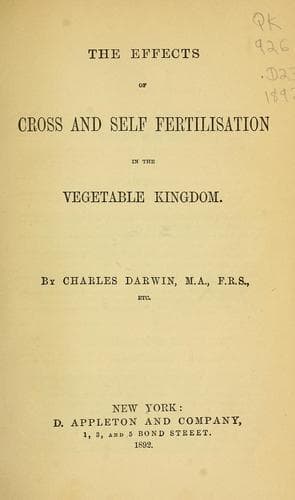
The Effects of Cross & Self-Fertilisation in the Vegetable KingdomDarwin, Charles
Science
The Effects of Cross & Self-Fertilisation in the Vegetable Kingdom
Darwin, Charles
Fertilization of plants; Plants -- Variation; Pollination
In the summer of 1867 the trial was repeated; thirty flowers were
crossed with pollen from a distinct plant and produced twenty-seven
capsules, each containing five seeds. Thirty-two flowers were fertilised
with their own pollen, and produced only six capsules, each with five
seeds. So that the crossed and self-fertilised capsules contained the
same number of seeds, though many more capsules were produced by the
cross-fertilised than by the self-fertilised flowers, in the ratio of
100 to 21.
An equal number of seeds of both lots were weighed, and the crossed
seeds were to the self-fertilised in weight as 100 to 82. Therefore a
cross increases the number of capsules produced and the weight of the
seeds, but not the number of seeds in each capsule.
These two lots of seeds, after germinating on sand, were planted on the
opposite sides of three pots. The seedlings when from 6 to 7 inches in
height were equal. The plants were measured when fully grown, but their
heights were so unequal in the several pots, that the result cannot be
fully trusted.
TABLE 5/75. Nolana prostrata.
Heights of plants measured in inches.
Column 1: Number (Name) of Pot.
Column 2: Crossed Plants.
Column 3: Self-fertilised Plants.
Pot 1 : 8 4/8 : 4 2/8.
Pot 1 : 6 4/8 : 7 4/8.
Pot 2 : 10 4/8 : 14 4/8.
Pot 2 : 18 : 18.
Pot 3 : 20 2/8 : 22 6/8.
Total : 63.75 : 67.00.
The five crossed plants average 12.75, and the five self-fertilised 13.4
inches in height; or as 100 to 105.
CHAPTER VI.
SOLANACEAE, PRIMULACEAE, POLYGONEAE, ETC.
Petunia violacea, crossed and self-fertilised plants compared for four
generations.
Effects of a cross with a fresh stock.
Uniform colour of the flowers on the self-fertilised plants of the
fourth generation.
Nicotiana tabacum, crossed and self-fertilised plants of equal height.
Great effects of a cross with a distinct sub-variety on the height, but
not on the fertility, of the offspring.
Cyclamen persicum, crossed seedlings greatly superior to the self-fertilised.
Anagallis collina.
Primula veris.
Equal-styled variety of Primula veris, fertility of, greatly increased
by a cross with a fresh stock.
Fagopyrum esculentum.
Beta vulgaris.
Canna warscewiczi, crossed and self-fertilised plants of equal height.
Zea mays.
Phalaris canariensis.
25. SOLANACEAE. Petunia violacea.
DINGY PURPLE VARIETY.
The flowers of this plant are so seldom visited during the day by
insects in this country, that I have never seen an instance; but my
gardener, on whom I can rely, once saw some humble-bees at work. Mr.
Meehan says, that in the United States bees bore through the corolla for
the nectar, and adds that their “fertilisation is carried on by
night-moths.” (6/1. ‘Proceedings of the Academy of Natural Science of
Philadelphia’ August 2, 1870 page 90.)
Public-domain text, read in full here on John Shaqi.
Reviews
Reviews
No reviews yet
Be the first to share your thoughts on this work.
Elsewhere in the archive
Join the Discussion
Join the discussion
Sign in to leave a comment or review.
Sign InorCreate an account