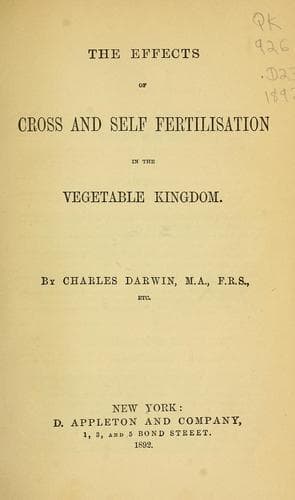
The Effects of Cross & Self-Fertilisation in the Vegetable KingdomDarwin, Charles
Science
The Effects of Cross & Self-Fertilisation in the Vegetable Kingdom
Darwin, Charles
Fertilization of plants; Plants -- Variation; Pollination
In France M. Naudin, after castrating a large number of flowers whilst
in bud, left them exposed to the visits of insects, and about a quarter
produced capsules (6/2. ‘Annales des Sc. Nat.’ 4th series Bot. Tome 9
cah. 5); but I am convinced that a much larger proportion of flowers in
my garden are cross-fertilised by insects, for protected flowers with
their own pollen placed on the stigma never yielded nearly a full
complement of seed; whilst those left uncovered produced fine capsules,
showing that pollen from other plants must have been brought to them,
probably by moths. Plants growing vigorously and flowering in pots in
the greenhouse, never yielded a single capsule; and this may be
attributed, at least in chief part, to the exclusion of moths.
Six flowers on a plant covered by a net were crossed with pollen from a
distinct plant and produced six capsules, containing by weight 4.44
grains of seed. Six other flowers were fertilised with their own pollen
and produced only three capsules, containing only 1.49 grains weight of
seed. From this it follows that an equal number of crossed and
self-fertilised capsules would have contained seeds by weight as 100 to
67. I should not have thought the proportional contents of so few
capsules worth giving, had not nearly the same result been confirmed by
several subsequent trials.
Seeds of the two lots were placed on sand, and many of the
self-fertilised seeds germinated before the crossed, and were rejected.
Several pairs in an equal state of germination were planted on the
opposite sides of Pots 1 and 2; but only the tallest plant on each side
was measured. Seeds were also sown thickly on the two sides of a large
pot (3), the seedlings being afterwards thinned, so that an equal number
was left on each side; the three tallest on each side being measured.
The pots were kept in the greenhouse, and the plants were trained up
sticks. For some time the young crossed plants had no advantage in
height over the self-fertilised; but their leaves were larger. When
fully grown and in flower the plants were measured, as follows:--
TABLE 6/76. Petunia violacea (first generation).
Heights of plants measured in inches.
Column 1: Number (Name) of Pot.
Column 2: Crossed Plants.
Column 3: Self-fertilised Plants.
Pot 1 : 30 : 20 4/8.
Pot 2 : 34 4/8 : 27 4/8.
Pot 3 : 34 : 28 4/8.
Pot 3 : 30 4/8 : 27 4/8.
Pot 3 : 25 : 26.
Total : 154 : 130.
The five tallest crossed plants here average 30.8, and the five tallest
self-fertilised 26 inches in height, or as 100 to 84.
Three capsules were obtained by crossing flowers on the above crossed
plants, and three other capsules by again self-fertilising flowers on
the self-fertilised plants. One of the latter capsules appeared as fine
as any one of the crossed capsules; but the other two contained many
imperfect seeds. From these two lots of seeds the plants of the
following generation were raised.
Public-domain text, read in full here on John Shaqi.
Reviews
Reviews
No reviews yet
Be the first to share your thoughts on this work.
Elsewhere in the archive
Join the Discussion
Join the discussion
Sign in to leave a comment or review.
Sign InorCreate an account