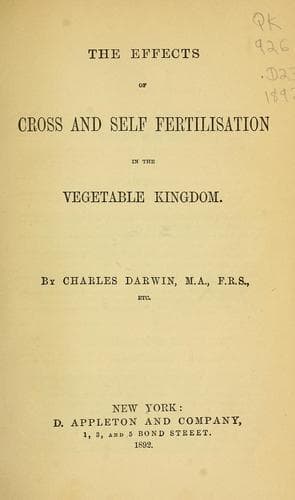
The Effects of Cross & Self-Fertilisation in the Vegetable KingdomDarwin, Charles
Science
The Effects of Cross & Self-Fertilisation in the Vegetable Kingdom
Darwin, Charles
Fertilization of plants; Plants -- Variation; Pollination
If we now consider the crossed and self-fertilised plants of the three
generations, we find an extraordinary diversity in their relative
heights. In the first generation, the crossed plants were inferior to
the self-fertilised as 100 to 178; and the flowers on the original
parent-plants which were crossed with pollen from a distinct plant
yielded much fewer seeds than the self-fertilised flowers, in the
proportion of 100 to 150. But it is a strange fact that the
self-fertilised plants, which were subjected to very severe competition
with the crossed, had on two occasions no advantage over them. The
inferiority of the crossed plants of this first generation cannot be
attributed to the immaturity of the seeds, for I carefully examined
them; nor to the seeds being diseased or in any way injured in some one
capsule, for the contents of the ten crossed capsules were mingled
together and a few taken by chance for sowing. In the second generation
the crossed and self-fertilised plants were nearly equal in height. In
the third generation, crossed and self-fertilised seeds were obtained
from two plants of the previous generation, and the seedlings raised
from them differed remarkably in constitution; the crossed in the one
case exceeded the self-fertilised in height in the ratio of 100 to 83,
and in the other case were almost equal. This difference between the two
lots, raised at the same time from two plants growing in the same pot,
and treated in every respect alike, as well as the extraordinary
superiority of the self-fertilised over the crossed plants in the first
generation, considered together, make me believe that some individuals
of the present species differ to a certain extent from others in their
sexual affinities (to use the term employed by Gartner), like closely
allied species of the same genus. Consequently if two plants which thus
differ are crossed, the seedlings suffer and are beaten by those from
the self-fertilised flowers, in which the sexual elements are of the
same nature. It is known that with our domestic animals certain
individuals are sexually incompatible, and will not produce offspring,
although fertile with other individuals. (6/3. I have given evidence on
this head in my ‘Variation of Animals and Plants under Domestication’
chapter 18 2nd edition volume 2 page 146.) But Kolreuter has recorded a
case which bears more closely on our present one, as it shows that in
the genus Nicotiana the varieties differ in their sexual affinities.
(6/4. ‘Das Geschlecht der Pflanzen, Zweite Fortsetzung’ 1764 pages
55-60.) He experimented on five varieties of the common tobacco, and
proved that they were varieties by showing that they were perfectly
fertile when reciprocally crossed; but one of these varieties, if used
either as the father or the mother, was more fertile than any of the
others when crossed with a widely distinct species, N. glutinosa. As the
different varieties thus differ in their sexual affinities, there is
Public-domain text, read in full here on John Shaqi.
Reviews
Reviews
No reviews yet
Be the first to share your thoughts on this work.
Elsewhere in the archive
Join the Discussion
Join the discussion
Sign in to leave a comment or review.
Sign InorCreate an account