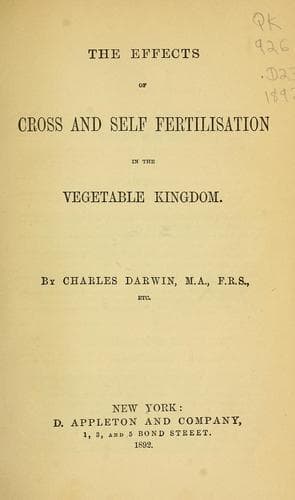
The Effects of Cross & Self-Fertilisation in the Vegetable KingdomDarwin, Charles
Science
The Effects of Cross & Self-Fertilisation in the Vegetable Kingdom
Darwin, Charles
Fertilization of plants; Plants -- Variation; Pollination
nothing surprising in the individuals of the same variety differing in a
like manner to a slight degree.
Taking the plants of the three generations altogether, the crossed show
no superiority over the self-fertilised, and I can account for this fact
only by supposing that with this species, which is perfectly
self-fertile without insect aid, most of the individuals are in the same
condition, as those of the same variety of the common pea and of a few
other exotic plants, which have been self-fertilised for many
generations. In such cases a cross between two individuals does no good;
nor does it in any case, unless the individuals differ in general
constitution, either from so-called spontaneous variation, or from their
progenitors having been subjected to different conditions. I believe
that this is the true explanation in the present instance, because, as
we shall immediately see, the offspring of plants, which did not profit
at all by being crossed with a plant of the same stock, profited to an
extraordinary degree by a cross with a slightly different sub-variety.
THE EFFECTS OF A CROSS WITH A FRESH STOCK.
I procured some seed of N. tabacum from Kew and raised some plants,
which formed a slightly different sub-variety from my former plants; as
the flowers were a shade pinker, the leaves a little more pointed, and
the plants not quite so tall. Therefore the advantage in height which
the seedlings gained by this cross cannot be attributed to direct
inheritance. Two of the plants of the third self-fertilised generation,
growing in Pots 2 and 5 in Table 6/87, which exceeded in height their
crossed opponents (as did their parents in a still higher degree) were
fertilised with pollen from the Kew plants, that is, by a fresh stock.
The seedlings thus raised may be called the Kew-crossed. Some other
flowers on the same two plants were fertilised with their own pollen,
and the seedlings thus raised from the fourth self-fertilised
generation. The crossed capsules produced by the plant in Pot 2, Table
6/87, were plainly less fine than the self-fertilised capsules on the
same plant. In Pot 5 the one finest capsule was also a self-fertilised
one; but the seeds produced by the two crossed capsules together
exceeded in number those produced by the two self-fertilised capsules on
the same plant. Therefore as far as the flowers on the parent-plants are
concerned, a cross with pollen from a fresh stock did little or no good;
and I did not expect that the offspring would have received any benefit,
but in this I was completely mistaken.
Public-domain text, read in full here on John Shaqi.
Reviews
Reviews
No reviews yet
Be the first to share your thoughts on this work.
Elsewhere in the archive
Join the Discussion
Join the discussion
Sign in to leave a comment or review.
Sign InorCreate an account