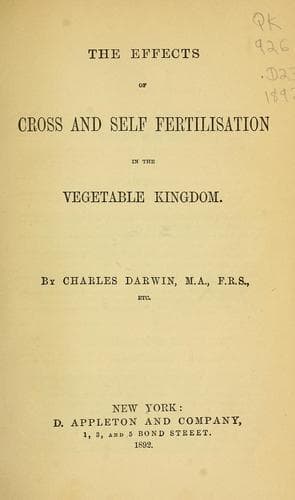
The Effects of Cross & Self-Fertilisation in the Vegetable KingdomDarwin, Charles
Science
The Effects of Cross & Self-Fertilisation in the Vegetable Kingdom
Darwin, Charles
Fertilization of plants; Plants -- Variation; Pollination
Pot 3 : 6 : 16 : 3 : 4.
Pot 3 : 6 2/8 : : 0 4/8.
Pot 4 : 7 3/8 : 14 : 2 5/8 : 5.
Pot 4 : 6 1/8 : : 2 4/8.
Total : 56.26 : 62 : 25.75 : 15.
The average height of the eight tallest flower-stems on the crossed
plants is here 7.03 inches, and that of the eight tallest flower-stems
on the self-fertilised plants 3.21 inches; or as 100 to 46. We see,
also, that the crossed plants bore sixty-two flower-stems; that is,
above four times as many as those (namely fifteen) borne by the
self-fertilised plants. The flowers were left exposed to the visits of
insects, and as many plants of both forms grew close by, they must have
been legitimately and naturally fertilised. Under these circumstances
the crossed plants produced 324 capsules, whilst the self-fertilised
produced only 16; and these were all produced by a single plant in Pot
2, which was much finer than any other self-fertilised plant. Judging by
the number of capsules produced, the fertility of an equal number of
crossed and self-fertilised plants was as 100 to 5.
In the succeeding year (1871) I did not count all the flower-stems on
these plants, but only those which produced capsules containing good
seeds. The season was unfavourable, and the crossed plants produced only
forty such flower-stems, bearing 168 good capsules, whilst the
self-fertilised plants produced only two such flower-stems, bearing only
6 capsules, half of which were very poor ones. So that the fertility of
the two lots, judging by the number of capsules, was as 100 to 3.5.
Public-domain text, read in full here on John Shaqi.
Reviews
Reviews
No reviews yet
Be the first to share your thoughts on this work.
Elsewhere in the archive
Join the Discussion
Join the discussion
Sign in to leave a comment or review.
Sign InorCreate an account