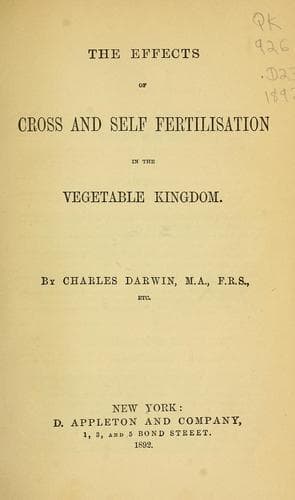
The Effects of Cross & Self-Fertilisation in the Vegetable KingdomDarwin, Charles
Science
The Effects of Cross & Self-Fertilisation in the Vegetable Kingdom
Darwin, Charles
Fertilization of plants; Plants -- Variation; Pollination
In considering the great difference in height and the wonderful
difference in fertility between the two sets of plants, we should bear
in mind that this is the result of two distinct agencies. The
self-fertilised plants were the product of illegitimate fertilisation
during five successive generations, in all of which, excepting the last,
the plants had been fertilised with pollen taken from a distinct
individual belonging to the same form, but which was more or less
closely related. The plants had also been subjected in each generation
to closely similar conditions. This treatment alone, as I know from
other observations, would have greatly reduced the size and fertility of
the offspring. On the other hand, the crossed plants were the offspring
of long-styled plants of the fourth illegitimate generation legitimately
crossed with pollen from a short-styled plant, which, as well as its
progenitors, had been exposed to very different conditions; and this
latter circumstance alone would have given great vigour to the
offspring, as we may infer from the several analogous cases already
given. How much proportional weight ought to be attributed to these two
agencies,--the one tending to injure the self-fertilised offspring, and
the other to benefit the crossed offspring,--cannot be determined. But
we shall immediately see that the greater part of the benefit, as far as
increased fertility is concerned, must be attributed to the cross having
been made with a fresh stock.
Primula veris.
EQUAL-STYLED AND RED-FLOWERED VAR.
I have described in my paper ‘On the Illegitimate Unions of Dimorphic
and Trimorphic Plants’ this remarkable variety, which was sent to me
from Edinburgh by Mr. J. Scott. It possessed a pistil proper to the
long-styled form, and stamens proper to the short-styled form; so that
it had lost the heterostyled or dimorphic character common to most of
the species of the genus, and may be compared with an hermaphrodite form
of a bisexual animal. Consequently the pollen and stigma of the same
flower are adapted for complete mutual fertilisation, instead of its
being necessary that pollen should be brought from one form to another,
as in the common cowslip. From the stigma and anthers standing nearly on
the same level, the flowers are perfectly self-fertile when insects are
excluded. Owing to the fortunate existence of this variety, it is
possible to fertilise its flowers in a legitimate manner with their own
pollen, and to cross other flowers in a legitimate manner with pollen
from another variety or fresh stock. Thus the offspring from both unions
can be compared quite fairly, free from any doubt from the injurious
effects of an illegitimate union.
Public-domain text, read in full here on John Shaqi.
Reviews
Reviews
No reviews yet
Be the first to share your thoughts on this work.
Elsewhere in the archive
Join the Discussion
Join the discussion
Sign in to leave a comment or review.
Sign InorCreate an account