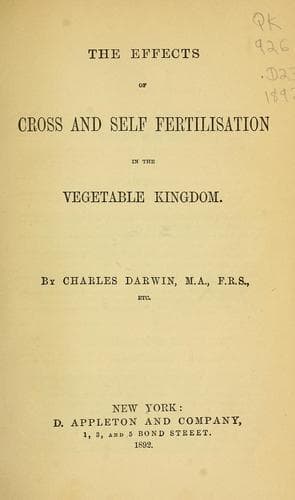
The Effects of Cross & Self-Fertilisation in the Vegetable KingdomDarwin, Charles
Science
The Effects of Cross & Self-Fertilisation in the Vegetable Kingdom
Darwin, Charles
Fertilization of plants; Plants -- Variation; Pollination
Plants when first subjected to culture, even in their native country,
cannot fail to be exposed to greatly changed conditions of life, more
especially from growing in cleared ground, and from not having to
compete with many or any surrounding plants. They are thus enabled to
absorb whatever they require which the soil may contain. Fresh seeds are
often brought from distant gardens, where the parent-plants have been
subjected to different conditions. Cultivated plants like those in a
state of nature frequently intercross, and will thus mingle their
constitutional peculiarities. On the other hand, as long as the
individuals of any species are cultivated in the same garden, they will
apparently be subjected to more uniform conditions than plants in a
state of nature, as the individuals have not to compete with various
surrounding species. The seeds sown at the same time in a garden have
generally been matured during the same season and in the same place; and
in this respect they differ much from the seeds sown by the hand of
nature. Some exotic plants are not frequented by the native insects in
their new home, and therefore are not intercrossed; and this appears to
be a highly important factor in the individuals acquiring uniformity of
constitution.
In my experiments the greatest care was taken that in each generation
all the crossed and self-fertilised plants should be subjected to the
same conditions. Not that the conditions were absolutely the same, for
the more vigorous individuals will have robbed the weaker ones of
nutriment, and likewise of water when the soil in the pots was becoming
dry; and both lots at one end of the pot will have received a little
more light than those at the other end. In the successive generations,
the plants were subjected to somewhat different conditions, for the
seasons necessarily varied, and they were sometimes raised at different
periods of the year. But as they were all kept under glass, they were
exposed to far less abrupt and great changes of temperature and moisture
than are plants growing out of doors. With respect to the intercrossed
plants, their first parents, which were not related, would almost
certainly have differed somewhat in constitution; and such
constitutional peculiarities would be variously mingled in each
succeeding intercrossed generation, being sometimes augmented, but more
commonly neutralised in a greater or less degree, and sometimes revived
through reversion; just as we know to be the case with the external
characters of crossed species and varieties. With the plants which were
self-fertilised during the successive generations, this latter important
source of some diversity of constitution will have been wholly
eliminated; and the sexual elements produced by the same flower must
have been developed under as nearly the same conditions as it is
possible to conceive.
Public-domain text, read in full here on John Shaqi.
Reviews
Reviews
No reviews yet
Be the first to share your thoughts on this work.
Elsewhere in the archive
Join the Discussion
Join the discussion
Sign in to leave a comment or review.
Sign InorCreate an account