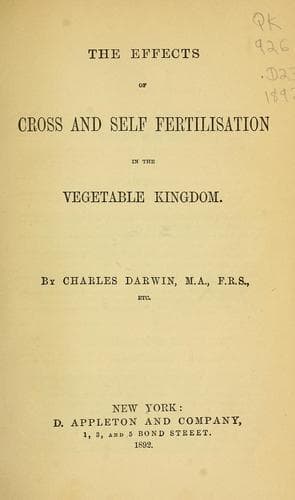
The Effects of Cross & Self-Fertilisation in the Vegetable KingdomDarwin, Charles
Science
The Effects of Cross & Self-Fertilisation in the Vegetable Kingdom
Darwin, Charles
Fertilization of plants; Plants -- Variation; Pollination
In Table 7/C the crossed plants are the offspring of a cross with a
fresh stock, or with a distinct variety; and they were put into
competition either with self-fertilised plants, or with intercrossed
plants of the same old stock. By the term fresh stock I mean a
non-related plant, the progenitors of which have been raised during some
generations in another garden, and have consequently been exposed to
somewhat different conditions. In the case of Nicotiana, Iberis, the red
variety of Primula, the common Pea, and perhaps Anagallis, the plants
which were crossed may be ranked as distinct varieties or sub-varieties
of the same species; but with Ipomoea, Mimulus, Dianthus, and Petunia,
the plants which were crossed differed exclusively in the tint of their
flowers; and as a large proportion of the plants raised from the same
lot of purchased seeds thus varied, the differences may be estimated as
merely individual. Having made these preliminary remarks, we will now
consider in detail the several cases given in Table 7/C, and they are
well worthy of full consideration.
1. Ipomoea purpurea.
Plants growing in the same pots, and subjected in each generation to the
same conditions, were intercrossed for nine consecutive generations.
These intercrossed plants thus became in the later generations more or
less closely inter-related. Flowers on the plants of the ninth
intercrossed generation were fertilised with pollen taken from a fresh
stock, and seedlings thus raised. Other flowers on the same intercrossed
plants were fertilised with pollen from another intercrossed plant,
producing seedlings of the tenth intercrossed generation. These two sets
of seedlings were grown in competition with one another, and differed
greatly in height and fertility. For the offspring from the cross with a
fresh stock exceeded in height the intercrossed plants in the ratio of
100 to 78; and this is nearly the same excess which the intercrossed had
over the self-fertilised plants in all ten generations taken together,
namely, as 100 to 77. The plants raised from the cross with a fresh
stock were also greatly superior in fertility to the intercrossed,
namely, in the ratio of 100 to 51, as judged by the relative weight of
the seed-capsules produced by an equal number of plants of the two sets,
both having been left to be naturally fertilised. It should be
especially observed that none of the plants of either lot were the
product of self-fertilisation. On the contrary, the intercrossed plants
had certainly been crossed for the last ten generations, and probably,
during all previous generations, as we may infer from the structure of
the flowers and from the frequency of the visits of humble-bees. And so
it will have been with the parent-plants of the fresh stock. The whole
great difference in height and fertility between the two lots must be
attributed to the one being the product of a cross with pollen from a
fresh stock, and the other of a cross between plants of the same old
Public-domain text, read in full here on John Shaqi.
Reviews
Reviews
No reviews yet
Be the first to share your thoughts on this work.
Elsewhere in the archive
Join the Discussion
Join the discussion
Sign in to leave a comment or review.
Sign InorCreate an account