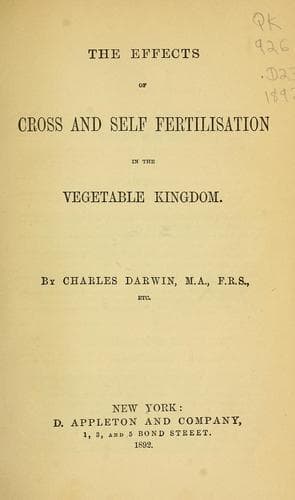
The Effects of Cross & Self-Fertilisation in the Vegetable KingdomDarwin, Charles
Science
The Effects of Cross & Self-Fertilisation in the Vegetable Kingdom
Darwin, Charles
Fertilization of plants; Plants -- Variation; Pollination
This plant offers an almost unique case, inasmuch as the good effects of
a cross are confined to the reproductive system. Intercrossed and
self-fertilised plants of the English stock did not differ in height
(nor in weight, as far as was ascertained) in any constant manner; the
self-fertilised plants usually having the advantage. So it was with the
offspring of plants of the Brazilian stock, tried in the same manner.
The parent-plants, however, of the English stock produced many more
seeds when fertilised with pollen from another plant than when
self-fertilised; and in Brazil the parent-plants were absolutely sterile
unless they were fertilised with pollen from another plant. Intercrossed
seedlings, raised in England from the Brazilian stock, compared with
self-fertilised seedlings of the corresponding second generation,
yielded seeds in number as 100 to 89; both lots of plants being left
freely exposed to the visits of insects. If we now turn to the effects
of crossing plants of the Brazilian stock with pollen from the English
stock,--so that plants which had been long exposed to very different
conditions were intercrossed,--we find that the offspring were, as
before, inferior in height and weight to the plants of the Brazilian
stock after two generations of self-fertilisation, but were superior to
them in the most marked manner in the number of seeds produced, namely,
as 100 to 40; both lots of plants being left freely exposed to the
visits of insects.
In the case of Ipomoea, we have seen that the plants derived from a
cross with a fresh stock were superior in height as 100 to 78, and in
fertility as 100 to 51, to the plants of the old stock, although these
had been intercrossed during the last ten generations. With
Eschscholtzia we have a nearly parallel case, but only as far as
fertility is concerned, for the plants derived from a cross with a fresh
stock were superior in fertility in the ratio of 100 to 45 to the
Brazilian plants, which had been artificially intercrossed in England
for the two last generations, and which must have been naturally
intercrossed by insects during all previous generations in Brazil, where
otherwise they are quite sterile.
6. Dianthus caryophyllus.
Plants self-fertilised for three generations were crossed with pollen
from a fresh stock, and their offspring were grown in competition with
plants of the fourth self-fertilised generation. The crossed plants thus
obtained were to the self-fertilised in height as 100 to 81, and in
fertility (both lots being left to be naturally fertilised by insects)
as 100 to 33.
These same crossed plants were also to the offspring from the plants of
the third generation crossed by the intercrossed plants of the
corresponding generation, in height as 100 to 85, and in fertility as
100 to 45.
Public-domain text, read in full here on John Shaqi.
Reviews
Reviews
No reviews yet
Be the first to share your thoughts on this work.
Elsewhere in the archive
Join the Discussion
Join the discussion
Sign in to leave a comment or review.
Sign InorCreate an account