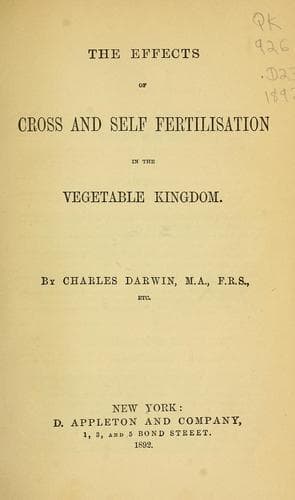
The Effects of Cross & Self-Fertilisation in the Vegetable KingdomDarwin, Charles
Science
The Effects of Cross & Self-Fertilisation in the Vegetable Kingdom
Darwin, Charles
Fertilization of plants; Plants -- Variation; Pollination
The intercrossed plants of the same stock in four out of the five
successive generations plainly exceeded in height the self-fertilised
plants. The latter in the fourth generation were crossed by a fresh
stock, and the seedlings thus obtained were put into competition with
the self-fertilised plants of the fifth generation. The crossed plants
exceeded the self-fertilised in height in the ratio of 100 to 66, and in
weight as 100 to 23; but this difference, though so great, is not much
greater than that between the intercrossed plants of the same stock in
comparison with the self-fertilised plants of the corresponding
generation. This case, therefore, seems at first sight opposed to the
rule that a cross with a fresh stock is much more beneficial than a
cross between individuals of the same stock. But as with Eschscholtzia,
the reproductive system was here chiefly benefited; for the plants
raised from the cross with the fresh stock were to the self-fertilised
plants in fertility, both lots being naturally fertilised, as 100 to 46,
whereas the intercrossed plants of the same stock were to the
self-fertilised plants of the corresponding fifth generation in
fertility only as 100 to 86.
Although at the time of measurement the plants raised from the cross
with the fresh stock did not exceed in height or weight the intercrossed
plants of the old stock (owing to the growth of the former not having
been completed, as explained under the head of this species), yet they
exceeded the intercrossed plants in fertility in the ratio of 100 to 54.
This fact is interesting, as it shows that plants self-fertilised for
four generations and then crossed by a fresh stock, yielded seedlings
which were nearly twice as fertile as those from plants of the same
stock which had been intercrossed for the five previous generations. We
here see, as with Eschscholtzia and Dianthus, that the mere act of
crossing, independently of the state of the crossed plants, has little
efficacy in giving increased fertility to the offspring. The same
conclusion holds good, as we have already seen, in the analogous cases
of Ipomoea, Mimulus, and Dianthus, with respect to height.
10. Nicotiana tabacum.
Public-domain text, read in full here on John Shaqi.
Reviews
Reviews
No reviews yet
Be the first to share your thoughts on this work.
Elsewhere in the archive
Join the Discussion
Join the discussion
Sign in to leave a comment or review.
Sign InorCreate an account