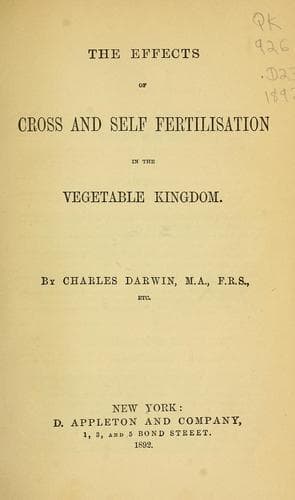
The Effects of Cross & Self-Fertilisation in the Vegetable KingdomDarwin, Charles
Science
The Effects of Cross & Self-Fertilisation in the Vegetable Kingdom
Darwin, Charles
Fertilization of plants; Plants -- Variation; Pollination
My plants were remarkably self-fertile, and the capsules from the
self-fertilised flowers apparently yielded more seeds than those which
were cross-fertilised. No insects were seen to visit the flowers in the
hothouse, and I suspect that the stock on which I experimented had been
raised under glass, and had been self-fertilised during several previous
generations; if so, we can understand why, in the course of three
generations, the crossed seedlings of the same stock did not uniformly
exceed in height the self-fertilised seedlings. But the case is
complicated by individual plants having different constitutions, so that
some of the crossed and self-fertilised seedlings raised at the same
time from the same parents behaved differently. However this may be,
plants raised from self-fertilised plants of the third generation
crossed by a slightly different sub-variety, exceeded greatly in height
and weight the self-fertilised plants of the fourth generation; and the
trial was made on a large scale. They exceeded them in height when grown
in pots, and not much crowded, in the ratio of 100 to 66; and when much
crowded, as 100 to 54. These crossed plants, when thus subjected to
severe competition, also exceeded the self-fertilised in weight in the
ratio of 100 to 37. So it was, but in a less degree (as may be seen in
Table 7/C), when the two lots were grown out of doors and not subjected
to any mutual competition. Nevertheless, strange as is the fact, the
flowers on the mother-plants of the third self-fertilised generation did
not yield more seed when they were crossed with pollen from plants of
the fresh stock than when they were self-fertilised.
11. Anagallis collina.
Plants raised from a red variety crossed by another plant of the same
variety were in height to the self-fertilised plants from the red
variety as 100 to 73. When the flowers on the red variety were
fertilised with pollen from a closely similar blue-flowered variety,
they yielded double the number of seeds to what they did when crossed by
pollen from another individual of the same red variety, and the seeds
were much finer. The plants raised from this cross between the two
varieties were to the self-fertilised seedlings from the red variety, in
height as 100 to 66, and in fertility as 100 to 6.
12. Primula veris.
Public-domain text, read in full here on John Shaqi.
Reviews
Reviews
No reviews yet
Be the first to share your thoughts on this work.
Elsewhere in the archive
Join the Discussion
Join the discussion
Sign in to leave a comment or review.
Sign InorCreate an account