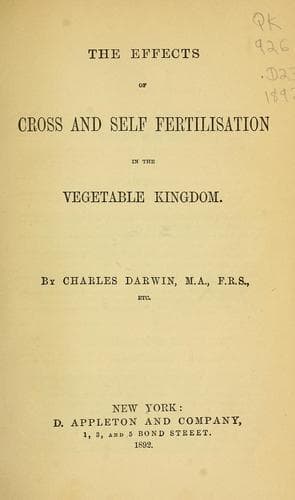
The Effects of Cross & Self-Fertilisation in the Vegetable KingdomDarwin, Charles
Science
The Effects of Cross & Self-Fertilisation in the Vegetable Kingdom
Darwin, Charles
Fertilization of plants; Plants -- Variation; Pollination
We will now turn to our first table, which relates to crossed and
self-fertilised plants of the same stock. These consist of fifty-four
species belonging to thirty natural orders. The total number of crossed
plants of which measurements are given is 796, and of self-fertilised
809; that is altogether 1,605 plants. Some of the species were
experimented on during several successive generations; and it should be
borne in mind that in such cases the crossed plants in each generation
were crossed with pollen from another crossed plant, and the flowers on
the self-fertilised plants were almost always fertilised with their own
pollen, though sometimes with pollen from other flowers on the same
plant. The crossed plants thus became more or less closely inter-related
in the later generations; and both lots were subjected in each
generation to almost absolutely the same conditions, and to nearly the
same conditions in the successive generations. It would have been a
better plan in some respects if I had always crossed some flowers either
on the self-fertilised or intercrossed plants of each generation with
pollen from a non-related plant, grown under different conditions, as
was done with the plants in Table 7/C; for by this procedure I should
have learnt how much the offspring became deteriorated through continued
self-fertilisation in the successive generations. As the case stands,
the self-fertilised plants of the successive generations in Table 7/A
were put into competition with and compared with intercrossed plants,
which were probably deteriorated in some degree by being more or less
inter-related and grown under similar conditions. Nevertheless, had I
always followed the plan in Table 7/C, I should not have discovered the
important fact that, although a cross between plants which are rather
closely related and which had been subjected to closely similar
conditions, gives during several generations some advantage to the
offspring, yet that after a time they may be intercrossed with no
advantage whatever to the offspring. Nor should I have learnt that the
self-fertilised plants of the later generations might be crossed with
intercrossed plants of the same stock with little or no advantage,
although they profited to an extraordinary degree by a cross with a
fresh stock.
Public-domain text, read in full here on John Shaqi.
Reviews
Reviews
No reviews yet
Be the first to share your thoughts on this work.
Elsewhere in the archive
Join the Discussion
Join the discussion
Sign in to leave a comment or review.
Sign InorCreate an account