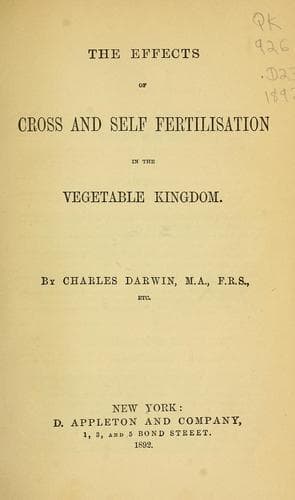
The Effects of Cross & Self-Fertilisation in the Vegetable KingdomDarwin, Charles
Science
The Effects of Cross & Self-Fertilisation in the Vegetable Kingdom
Darwin, Charles
Fertilization of plants; Plants -- Variation; Pollination
It cannot be maintained that
the benefit thus derived is due merely to the plants of the fresh stock
being perfectly healthy, whilst those which had been long intercrossed
or self-fertilised had become unhealthy; for in most cases there was no
appearance of such unhealthiness, and we shall see under Table 7/A that
the intercrossed plants of the same stock are generally superior to a
certain extent to the self-fertilised,--both lots having been subjected
to exactly the same conditions and being equally healthy or unhealthy.
We further learn from Table 7/C, that a cross between plants that have
been self-fertilised during several successive generations and kept all
the time under nearly uniform conditions, does not benefit the offspring
in the least or only in a very slight degree. Mimulus and the
descendants of Ipomoea named Hero offer instances of this rule. Again,
plants self-fertilised during several generations profit only to a small
extent by a cross with intercrossed plants of the same stock (as in the
case of Dianthus), in comparison with the effects of a cross by a fresh
stock. Plants of the same stock intercrossed during several generations
(as with Petunia) were inferior in a marked manner in fertility to those
derived from the corresponding self-fertilised plants crossed by a fresh
stock. Lastly, certain plants which are regularly intercrossed by
insects in a state of nature, and which were artificially crossed in
each succeeding generation in the course of my experiments, so that they
can never or most rarely have suffered any evil from self-fertilisation
(as with Eschscholtzia and Ipomoea), nevertheless profited greatly by a
cross with a fresh stock. These several cases taken together show us in
the clearest manner that it is not the mere crossing of any two
individuals which is beneficial to the offspring. The benefit thus
derived depends on the plants which are united differing in some manner,
and there can hardly be a doubt that it is in the constitution or nature
of the sexual elements. Anyhow, it is certain that the differences are
not of an external nature, for two plants which resemble each other as
closely as the individuals of the same species ever do, profit in the
plainest manner when intercrossed, if their progenitors have been
exposed during several generations to different conditions. But to this
latter subject I shall have to recur in a future chapter.
TABLE 7/A.
Public-domain text, read in full here on John Shaqi.
Reviews
Reviews
No reviews yet
Be the first to share your thoughts on this work.
Elsewhere in the archive
Join the Discussion
Join the discussion
Sign in to leave a comment or review.
Sign InorCreate an account