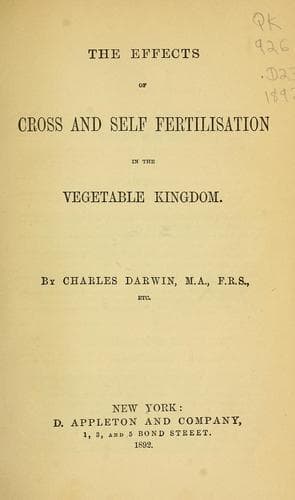
The Effects of Cross & Self-Fertilisation in the Vegetable KingdomDarwin, Charles
Science
The Effects of Cross & Self-Fertilisation in the Vegetable Kingdom
Darwin, Charles
Fertilization of plants; Plants -- Variation; Pollination
This plant was experimented on during four generations, in three of
which the crossed plants exceeded in height the self-fertilised
generally by much more than five per cent; and we have seen under Table
7/C that the offspring from the plants of the third self-fertilised
generation crossed by a fresh stock profited in height and fertility to
an extraordinary degree. But in this third generation the crossed plants
of the same stock were in height to the self-fertilised only as 100 to
99, that is, they were practically equal. Nevertheless, when the eight
crossed and eight self-fertilised plants were cut down and weighed, the
former were to the latter in weight as 100 to 49! There can therefore be
not the least doubt that the crossed plants of this species are greatly
superior in vigour and luxuriance to the self-fertilised; and what was
the cause of the self-fertilised plants of the third generation, though
so light and thin, growing up so as almost to equal the crossed in
height, I cannot explain.
2. Lobelia fulgens (first generation).
The crossed plants of this generation were much inferior in height to
the self-fertilised, in the proportion of 100 to 127. Although only two
pairs were measured, which is obviously much too few to be trusted, yet
from other evidence given under the head of this species, it is certain
that the self-fertilised plants were very much more vigorous than the
crossed. As I used pollen of unequal maturity for crossing and
self-fertilising the parent-plants, it is possible that the great
difference in the growth of their offspring may have been due to this
cause. In the next generation this source of error was avoided, and many
more plants were raised, and now the average height of the twenty-three
crossed plants was to that of the twenty-three self-fertilised plants as
100 to 91. We can therefore hardly doubt that a cross is beneficial to
this species.
3. Petunia violacea (third generation).
Public-domain text, read in full here on John Shaqi.
Reviews
Reviews
No reviews yet
Be the first to share your thoughts on this work.
Elsewhere in the archive
Join the Discussion
Join the discussion
Sign in to leave a comment or review.
Sign InorCreate an account