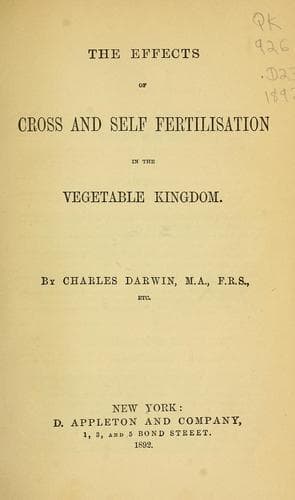
The Effects of Cross & Self-Fertilisation in the Vegetable KingdomDarwin, Charles
Science
The Effects of Cross & Self-Fertilisation in the Vegetable Kingdom
Darwin, Charles
Fertilization of plants; Plants -- Variation; Pollination
Eight crossed plants were to eight self-fertilised of the third
generation in average height as 100 to 131; and at an early age the
crossed were inferior even in a still higher degree. But it is a
remarkable fact that in one pot in which plants of both lots grew
extremely crowded, the crossed were thrice as tall as the
self-fertilised. As in the two preceding and two succeeding generations,
as well as with plants raised by a crossed with a fresh stock, the
crossed greatly exceeded the self-fertilised in height, weight, and
fertility (when these two latter points were attended to), the present
case must be looked at as an anomaly not affecting the general rule. The
most probable explanation is that the seeds from which the crossed
plants of the third generation were raised were not well ripened; for I
have observed an analogous case with Iberis. Self-fertilised seedlings
of this latter plant, which were known to have been produced from seeds
not well matured, grew from the first much more quickly than the crossed
plants, which were raised from better matured seeds; so that having thus
once got a great start they were enabled ever afterwards to retain their
advantage. Some of these same seeds of the Iberis were sown on the
opposite sides of pots filled with burnt earth and pure sand, not
containing any organic matter; and now the young crossed seedlings grew
during their short life to double the height of the self-fertilised, in
the same manner as occurred with the above two sets of seedlings of
Petunia which were much crowded and thus exposed to very unfavourable
conditions. We have seen also in the eighth generation of Ipomoea that
the self-fertilised seedlings raised from unhealthy parents grew at
first very much more quickly than the crossed seedlings, so that they
were for a long time much taller, though ultimately beaten by them.
4, 5, 6. Eschscholtzia californica.
Four sets of measurements are given in Table 7/A. In one of these the
crossed plants exceed the self-fertilised in average height, so that
this is not one of the exceptions here to be considered. In two other
cases the crossed equalled the self-fertilised in height within five per
cent; and in the fourth case the self-fertilised exceeded the crossed by
above this limit. We have seen in Table 7/C that the whole advantage of
a cross by a fresh stock is confined to fertility, and so it was with
the intercrossed plants of the same stock compared with the
self-fertilised, for the former were in fertility to the latter as 100
to 89. The intercrossed plants thus have at least one important
advantage over the self-fertilised. Moreover, the flowers on the
parent-plants when fertilised with pollen from another individual of the
same stock yield far more seeds than when self-fertilised; the flowers
in this latter case being often quite sterile. We may therefore conclude
that a cross does some good, though it does not give to the crossed
seedlings increased powers of growth.
Public-domain text, read in full here on John Shaqi.
Reviews
Reviews
No reviews yet
Be the first to share your thoughts on this work.
Elsewhere in the archive
Join the Discussion
Join the discussion
Sign in to leave a comment or review.
Sign InorCreate an account