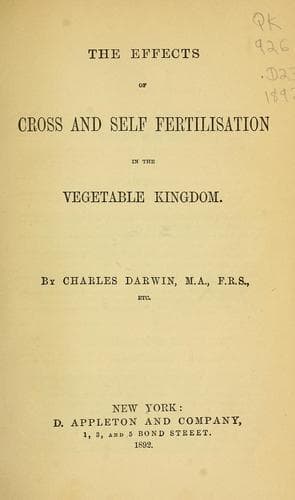
The Effects of Cross & Self-Fertilisation in the Vegetable KingdomDarwin, Charles
Science
The Effects of Cross & Self-Fertilisation in the Vegetable Kingdom
Darwin, Charles
Fertilization of plants; Plants -- Variation; Pollination
7. Viscaria oculata.
The average height of the fifteen intercrossed plants to that of the
fifteen self-fertilised plants was only as 100 to 97; but the former
produced many more capsules than the latter, in the ratio of 100 to 77.
Moreover, the flowers on the parent-plants which were crossed and
self-fertilised, yielded seeds on one occasion in the proportion of 100
to 38, and on a second occasion in the proportion of 100 to 58. So that
there can be no doubt about the beneficial effects of a cross, although
the mean height of the crossed plants was only three per cent above that
of the self-fertilised plants.
8. Specularia speculum.
Only the four tallest of the crossed and the four tallest of the
self-fertilised plants, growing in four pots, were measured; and the
former were to the latter in height as 100 to 98. In all four pots a
crossed plant flowered before any one of the self-fertilised plants, and
this is usually a safe indication of some real superiority in the
crossed plants. The flowers on the parent-plants which were crossed with
pollen from another plant yielded seeds compared with the
self-fertilised flowers in the ratio of 100 to 72. We may therefore draw
the same conclusion as in the last case with respect to a cross being
decidedly beneficial.
9. Borago officinalis.
Only four crossed and four self-fertilised plants were raised and
measured, and the former were to the latter in height as 100 to 102. So
small a number of measurements ought never to be trusted; and in the
present instance the advantage of the self-fertilised over the crossed
plants depended almost entirely on one of the self-fertilised plants
having grown to an unusual height. All four crossed plants flowered
before their self-fertilised opponents. The cross-fertilised flowers on
the parent-plants in comparison with the self-fertilised flowers yielded
seeds in the proportion of 100 to 60. So that here again we may draw the
same conclusion as in the two last cases.
10. Passiflora gracilis.
Only two crossed and two self-fertilised plants were raised; and the
former were to the latter in height as 100 to 104. On the other hand,
fruits from the cross-fertilised flowers on the parent-plants contained
seeds in number, compared with those from the self-fertilised flowers,
in the proportion of 100 to 85.
11. Phaseolus multiflorus.
The five crossed plants were to the five self-fertilised in height as
100 to 96. Although the crossed plants were thus only four per cent
taller than the self-fertilised, they flowered in both pots before them.
It is therefore probable that they had some real advantage over the
self-fertilised plants.
12. Adonis aestivalis.
The four crossed plants were almost exactly equal in height to the four
self-fertilised plants, but as so few plants were measured, and as these
were all “miserably unhealthy,” nothing can be inferred with safety with
respect to their relative heights.
13. Bartonia aurea.
Public-domain text, read in full here on John Shaqi.
Reviews
Reviews
No reviews yet
Be the first to share your thoughts on this work.
Elsewhere in the archive
Join the Discussion
Join the discussion
Sign in to leave a comment or review.
Sign InorCreate an account